For the instructor this paper is written for, Spark is one promise: the fastest way to showcase your mastery online. Everything that follows is the argument for why that matters — and the engine that makes it real.
How to read this paper. This is a long document by design — it brings together fifteen years of ideas into one connected argument. It is written in two parts:
- Main thread (sections 1–11) — tells the story and the vision for the instructor it's written for — any expert whose best teaching is locked inside recordings, whether a yoga instructor, a guitar instructor, or a home-cooking instructor; read it straight through.
- Appendix — deeper numbers, the evidence behind the learning-science claims, the business frameworks we lean on, and what we have measured in our own work — there if you want to inspect the foundations.
The main thread stands on its own. Every external factual claim is sourced. Capabilities carry a status tag so you know what is live today versus on the roadmap. Opinions and patterns from our own work are stated plainly in the narrative; the appendix holds the numbers, effect sizes, and evidence in depth:
- NOW — shipped or in live pilot.
- NEXT — in build / near-term.
- HORIZON — vision / roadmap.
1. A studio, an instructor, and a question I couldn't shake
For the better part of a decade I built a software consultancy and grew it to twenty-five people. I was proud of the work. I was also quietly wrecking my health to do it. Then my daughter was born, and something rearranged itself inside me. I wanted to be the kind of father she could point to — disciplined, healthy, growing. Before she turned one, I had somehow become a person who showed up to hour-long yoga classes several times a week.
If you'd known me a year earlier, you'd have found that hard to believe. This was a man who found even sitting in Vajrasana painful.
So what changed? My daughter's birth was the trigger that got me through the door. But a trigger gets you started; it doesn't keep you going. What kept me going was something quieter and far more powerful: my chemistry with my instructor.
On the mornings I wanted to skip, I went anyway — not out of willpower, but because I didn't want to let my instructor down. I had developed a deep, almost involuntary respect for her.
The courage it took to follow her calling. The years she'd poured into her craft. The way she could read a room of bodies and know exactly who needed a gentler word and who needed a firmer one. The rigor and discipline she brought into the room and expected from her students. The delight on her face when a student finally got something.
The respect I had for her did something strange and wonderful to the student in me: it made me coachable. I stopped arguing with the instructor in my head and started absorbing.
Over two years, I changed - not just my body, but my self-image. The story I told myself about myself flipped: "You're not that inconsistent, indisciplined guy anymore." … I was on cloud nine.
And then I noticed something that has bothered me ever since.
When I spoke about my instructor with the glow of a convert, people were unmoved. Friends, family — fine, they hadn't experienced her classes.
But the other students at the studio were unmoved too. The people who had practiced in that room with me, under the same instructor — why weren't they overflowing with the same respect I felt?
It didn't take long to find the answer — though it took me longer to find the words for it.
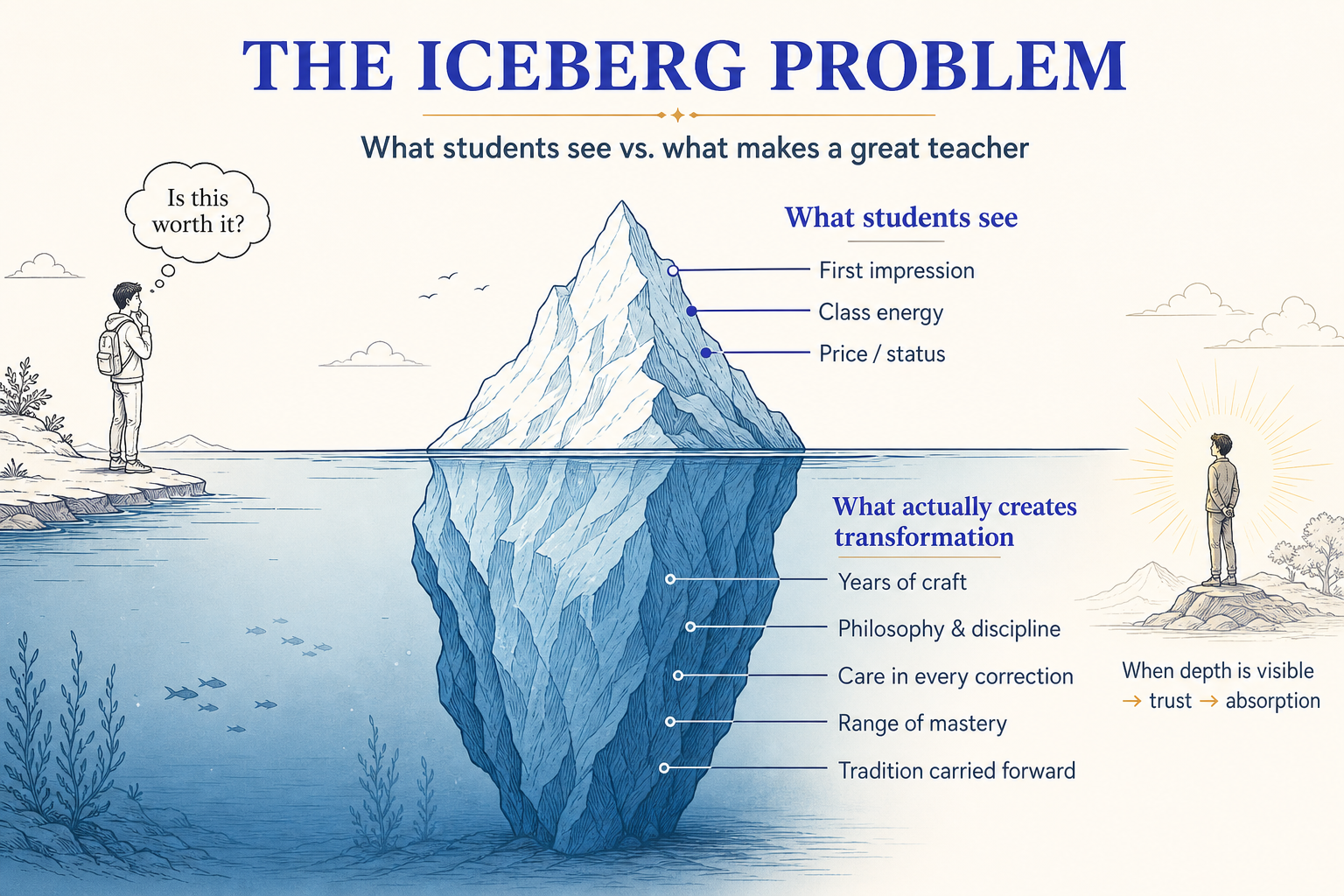
Picture an iceberg. Above the waterline is everything a student can judge in a glance: the energy in the room, a brand name or credential, the Instagram bio, whether this person seems "serious."
Below the waterline is almost everything that actually makes an instructor great — the years of practice, the philosophy they live by, the care they take with each correction, the range of topics they've mastered. A student reacting only to the tip is not being shallow; they simply have no way to see the mountain underneath.
I was luckier than most — but not because I was wiser. I had spent months reading about what yoga actually is: the philosophy behind the craft, and what it takes to devote a life to it. I already respected the discipline. Practicing with my instructor, I could see her as someone carrying that tradition forward — holding the torch after thousands of years. Her patience in the room, and the changes I was starting to feel in myself, made her depth visible.
Most students don't arrive with that preparation. They see the physical layer, the personality on the surface, and their minds stay in judgment mode because the depth isn't visible.
That is the uncomfortable answer: great instructors are icebergs, and most of the iceberg is underwater.
I happened to find this with a yoga instructor. But once I had the words for it, I saw it everywhere: the same gap sits under a guitar instructor, a home-cooking instructor, a portrait photographer, a ceramics instructor, a makeup artist, a fiction writer — anyone whose real depth stays invisible until you've spent serious time with them. Yoga is just where I noticed it first.
2. The two traps that keep great instructors small
2a. The Respect Gap
Return to the iceberg. The part that actually changes how much a student learns is not the tip they can see — it's whether they can glimpse anything of the mass below. When a student can't see the depth behind an instructor, part of their mind stays in judgment mode — quietly weighing whether this person is worth listening to — and a mind in judgment absorbs less than a mind that has decided to trust. This isn't a hunch: a respected, credible source is measurably more persuasive than an unproven one , and an instructor's belief in a student can lift that student's actual performance . Respect isn't just good manners; it's a learning input.
To be clear: this is not a claim that your students lack character. It's about what they can see — and what a mind does while depth stays hidden.
When depth is hidden, people reach for stand-ins: a known brand, an institution, a famous degree. In some fields that works — a surgeon's MD or a lawyer's degree from a top school carries the years behind it, legible at a glance. The Respect Gap bites hardest where no such ladder exists — where no title or alma mater can vouch for how far someone has gone, and the only way to see an instructor's mastery is to learn from them directly. Think of a yoga instructor, a guitar instructor, a home-cooking instructor, a portrait photographer, a ceramics instructor, a spoken English coach, a makeup artist, a fiction writer: the discipline sounds familiar at a glance, but the thousands of hours of practice, study, and refinement underneath stay invisible, with nothing official to point to. (For a longer — though still partial — list of domains where this pattern shows up, see the appendix.)
My instructor had that depth. Her students saw her as competent in class — good at her job — but not as someone carrying rare mastery they should be in awe of. Not because she lacked skill, but because there was no brand or institution behind her name, and almost nothing students could see before they committed made the range of what she had mastered browsable. The depth was there; it just wasn't legible. Hers is not a special case: wherever a craft runs deep but no license or famous institution stands in for that depth — and for most hands-on teaching, none does — mastery becomes a credence good, something a student can't reliably judge from the outside, so it stays invisible until they've already committed . The iceberg is often larger there, and the waterline sits higher.
That invisibility sets a trap — a loop that tightens the longer it runs. An instructor whose depth nobody can see is under-recognized; an under-recognized instructor's students half-listen; half-listening produces poorer results; poorer results lead to churn; and churn puts the instructor back on the treadmill of refilling the calendar. Still no bandwidth to make the submerged depth visible. Lose-lose.
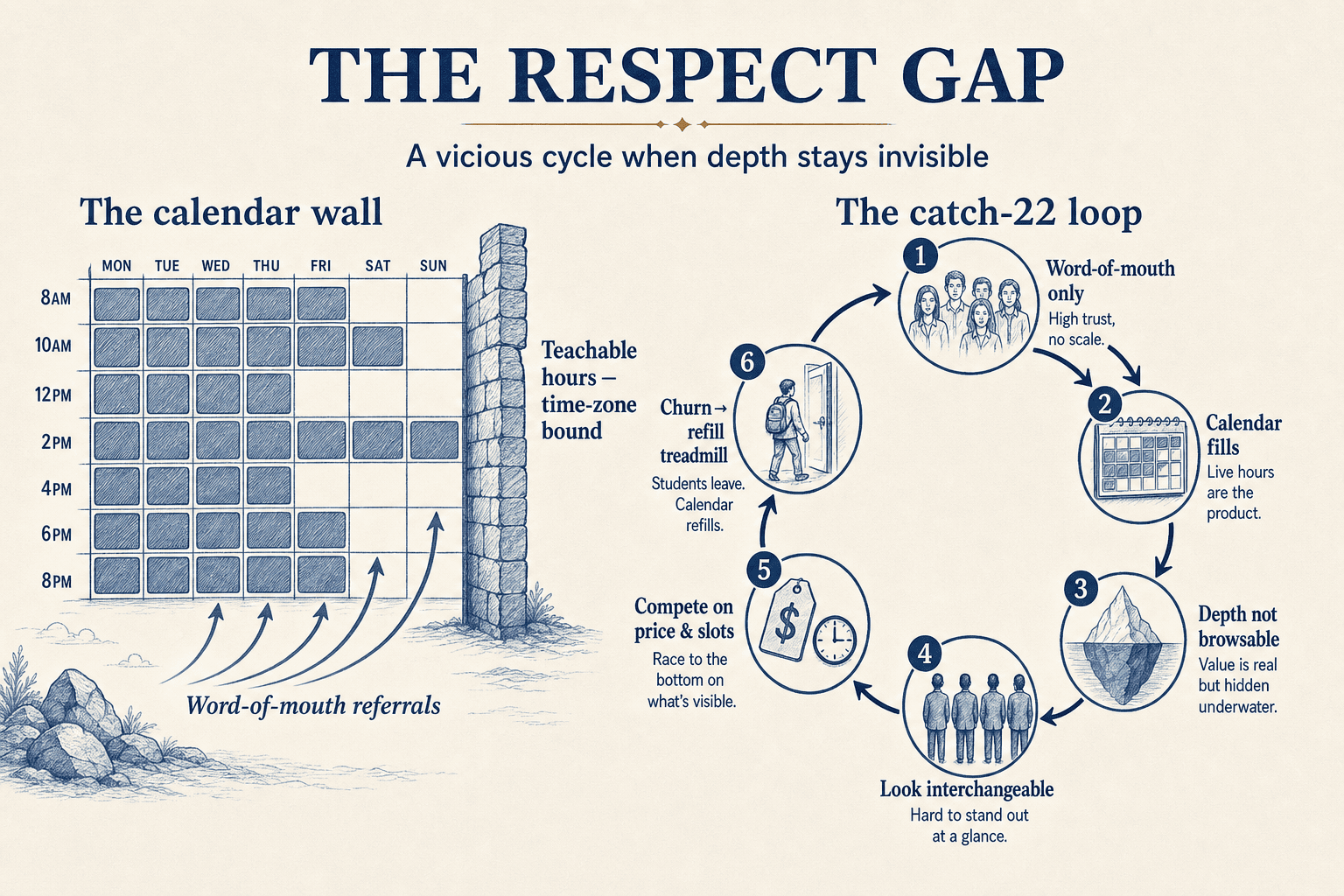
This is the Respect Gap: the distance between how much a great instructor is worth and how much the world can see they're worth — the gap between the iceberg's tip and its true mass. Spark's job is to help an instructor showcase their mastery — to make the depth visible — so respect is earned on the merits, and once it is, students learn more. Spark exists to close it.
2b. The Word-of-Mouth Ceiling
The Respect Gap is psychological. Its twin is structural, and just as suffocating.
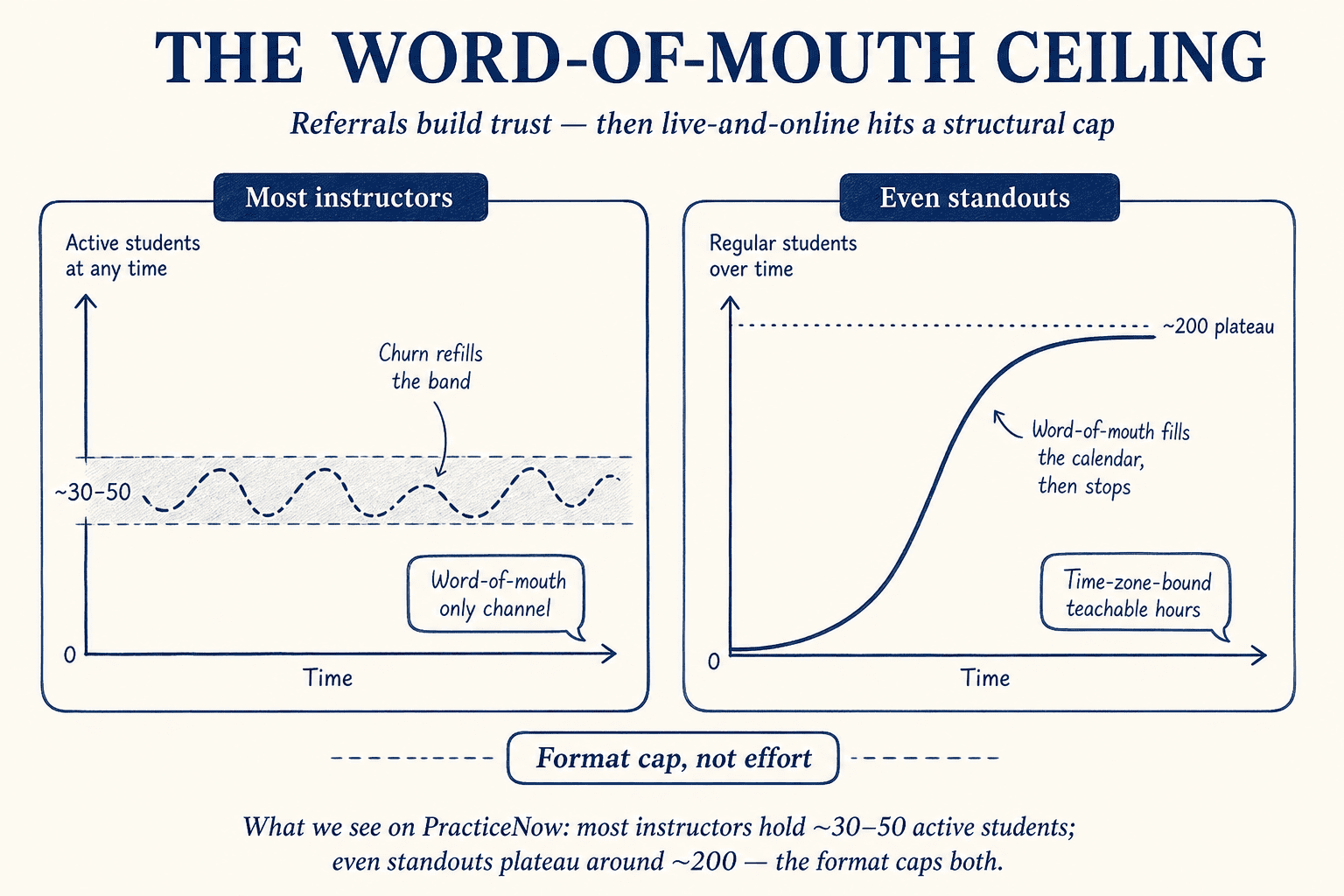
For most online live instructors we've worked with on PracticeNow, word of mouth is the only real marketing channel — a wonderful one, high trust and zero cost, but with a hard ceiling. We've watched the same pattern again and again: the very best instructors plateau around a couple of hundred regular students; most hover at thirty to fifty, churning constantly.
This is not bad luck; it's the math of the format. Live and online means time-zone-bound — there are only so many teachable hours that overlap with an instructor's waking day. Because the offering is never productized, it can't scale past the instructor's own clock. And because the instructor's real strengths — the submerged part of the iceberg — are locked away where students can't browse them, they have almost nothing to brand themselves with. So they end up looking like everyone else, which means they can't credibly claim a niche, which means they compete on price and availability — the very things their format makes scarce. A catch-22. (For the economics underneath this ceiling — how steeply creator income skews — see the appendix.)
And here's the cruelty of it: content alone doesn't rescue them. When teaching is shipped as undifferentiated information — a recording, a link, a PDF — people don't finish it. Across hundreds of large online courses, median completion runs in the low double digits and averages have been measured as low as ~6.5% . Information, dumped, doesn't transform anyone. Which is the hinge of this entire paper.
There's a quieter loss beneath that. In a regular class, most instructors teach the layer the majority of students showed up for — the shallow end of a deep well. The material that took years to earn tends to surface only now and then, in the occasional workshop or masterclass, for the smaller group who want to go deep — and once it's over, it disappears the same way — another recording, a link, a PDF that almost nobody opens again. Yet even the students who only ever wanted the shallow end learn better knowing the depth is there: it's the difference between being shown a step and being shown a step by someone who has walked the whole road. So the depth that would earn respect is both hard to see and rarely shipped.
There is a way out of both traps, and it is a single move: stop selling only live hours — capped by the clock — and turn the teaching itself into something that stands on its own and scales, without losing the depth or the instructor's voice. To productize your teaching in this way is how you break the Word-of-Mouth Ceiling. It is what the rest of this paper is about, and Spark is the bridge that gets an instructor there.
3. The real product is transformation, not information
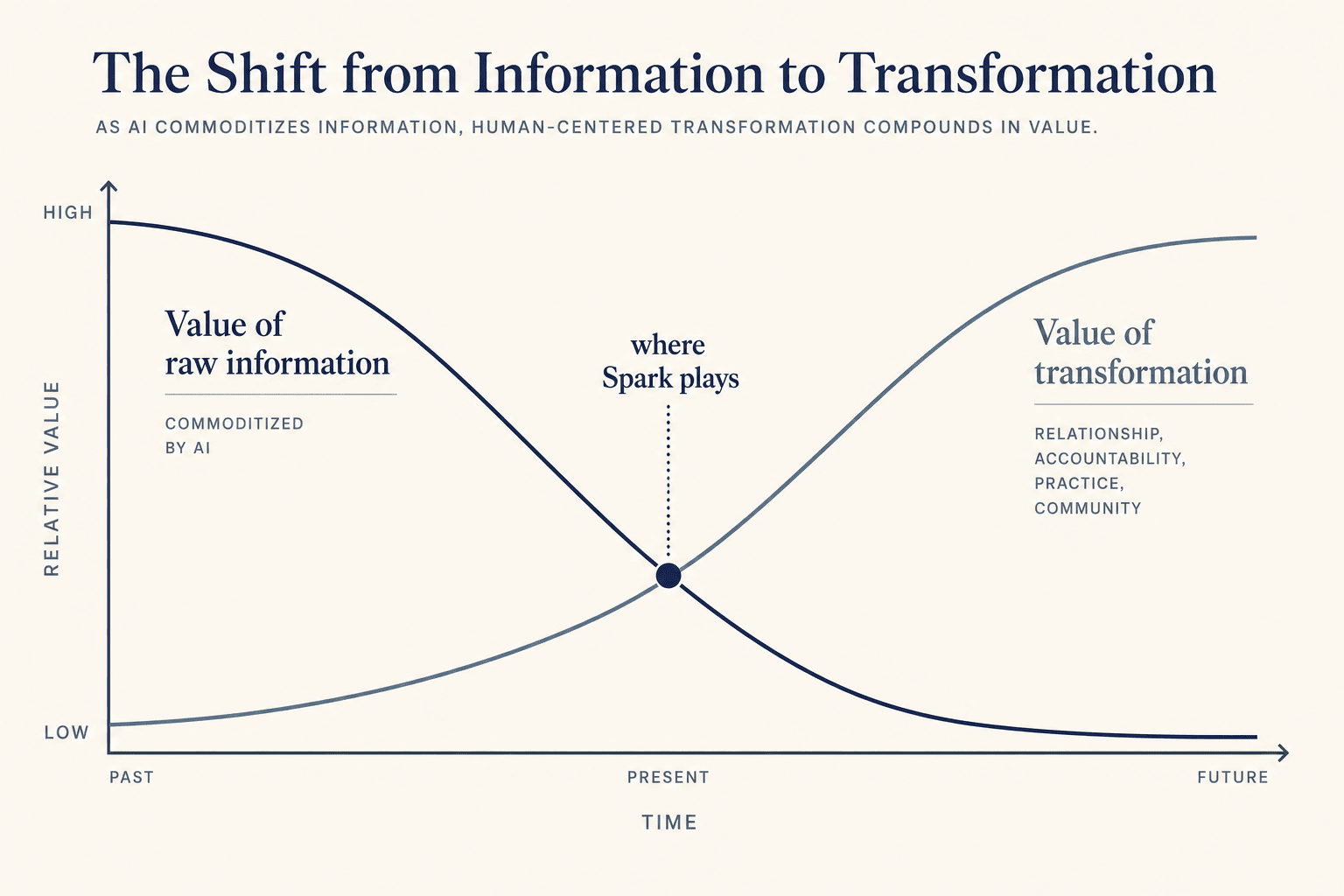
If AI can generate competent information on any topic instantly and for almost nothing, then selling information is a losing game. But here's the thing — people never really bought information in the first place. They bought transformation: becoming healthier, more skilled, more confident, more capable. Information was just the raw material we mistook for the product — a point many builders in the creator economy have argued, and one we think the completion data bears out.
The evidence that information-by-itself fails is everywhere, and we already saw it: when learning is delivered as pure content, almost no one completes it . What actually produces transformation is the layer around the information — a relationship with an instructor you respect, accountability, practice spaced over time, feedback, and a community that carries you when motivation dips.
That layer is exactly what AI cannot commoditize and exactly what the lone instructor is best in the world at providing. So the strategy writes itself: let AI handle the information; build an engine that amplifies the transformation. Everything else in this paper is a consequence of that single sentence.
4. The solution, in three parts
Section 3 made the turn: information is becoming free, so the real product is transformation — and transformation comes from the layer around the information: a relationship with an instructor you respect, accountability, practice spaced over time, feedback, and a community that carries you. The rest of this paper is how Spark builds that layer into something that scales beyond an instructor's live hours — the product that breaks the Word-of-Mouth Ceiling — and builds it so it runs without burning the instructor out.
It comes down to three things. Think of them as a trifecta, each carrying a different part of that transformation layer:
- Learning tools that transform — the science of how people actually absorb and retain, built into the course itself: retrieval, spacing, mastery, and one-on-one coaching. This is the part that works directly on the learner.
- A marketplace and communities of humans — discovery, so the right learners find the right instructor; and a living community around each instructor, where learners are carried by the instructor and by each other. This is the part that puts humans around the learner — the thing a lone instructor finds hardest to build.
- A team of AI agents that runs the business — a 24/7 team that works on the business so the instructor is freed to do the one thing only they can do: teach. This is the operator that makes the first two sustainable for one person.
None of the three floats in mid-air. They stand on shared foundations — the machinery that makes each pillar possible: the intelligence pulled from an instructor's own video, the commerce-and-operations backbone that already runs real teaching businesses, and the tool surface that lets the agents act rather than merely advise. Foundations first, then the three pillars, then the flywheel that makes them compound.
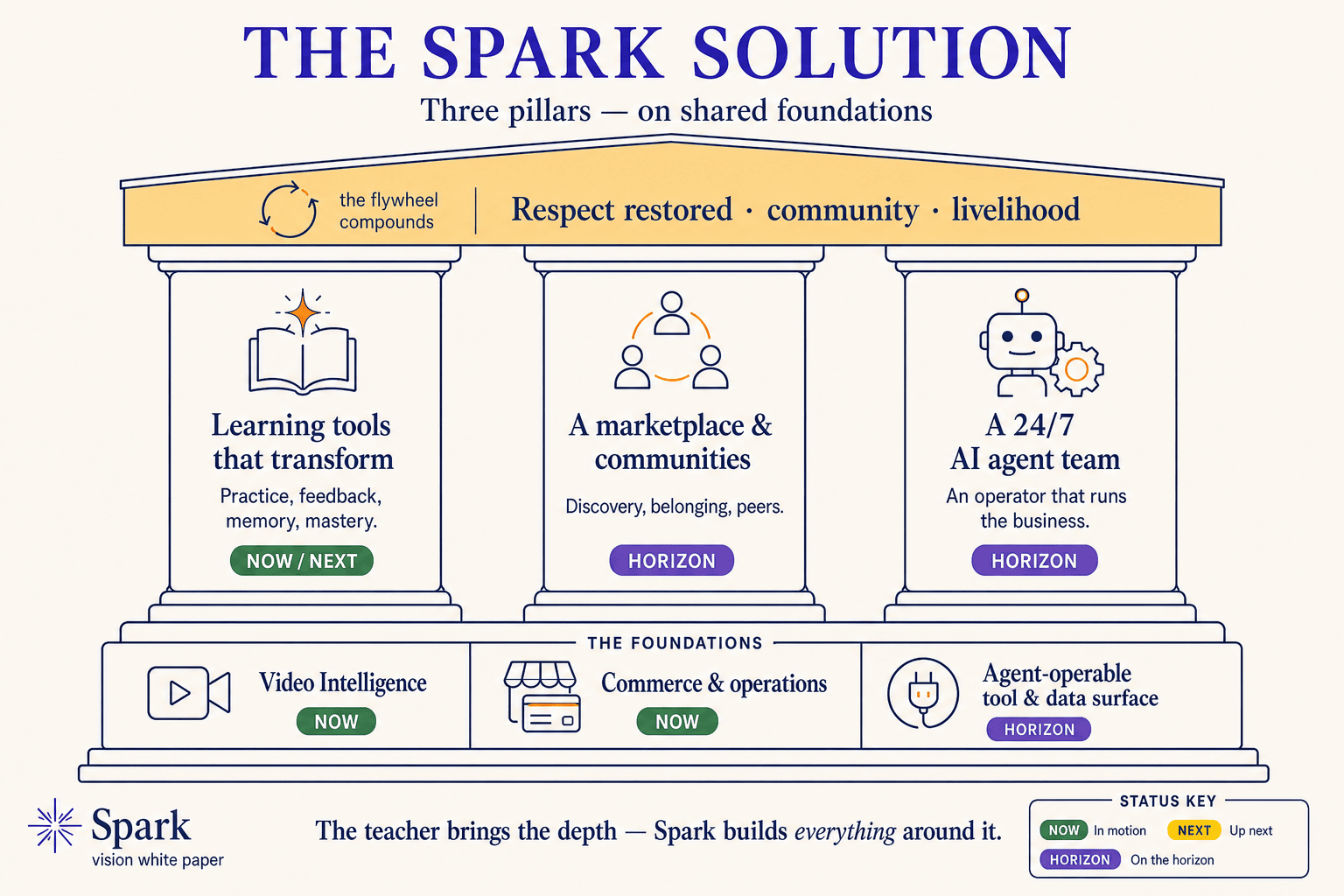
A reminder as we go in: some of this is live today, some is in build, and some is genuinely on the horizon — each capability keeps its status tag so you always know which is which.
5. The foundations Spark is built on
Before the pillars, the machinery they rest on. Spark begins not with features but with a conviction — that the people who help us grow deserve to be respected and to prosper for it — and builds three foundations in its service. (We owe the "start with why" instinct to Simon Sinek's Golden Circle; the framework note is in the appendix.)
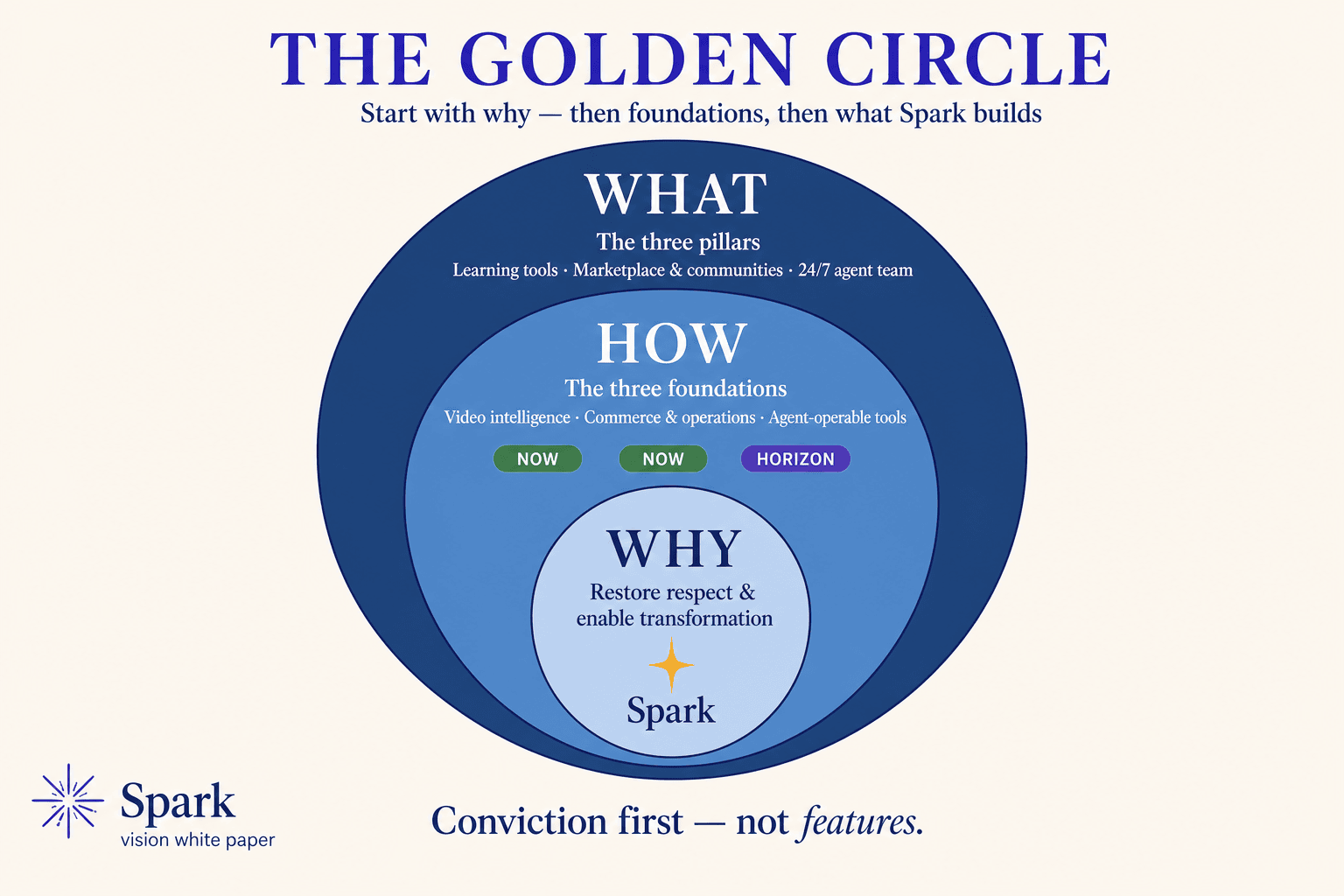
5a. Video Intelligence — the master unlock NOW
The iceberg has a bridge. Section 1 named the problem: students see the tip, not the depth. Most of that depth already exists — not in theory, but on hard drives and cloud accounts — inside recordings of the instructor's best sessions, often the very workshops and masterclasses where they finally taught the deep end. The bridge is not "make more content." It is to make the submerged depth browsable before anyone commits an hour of their life.
Picture what's sitting on instructors' hard drives and cloud accounts right now: carefully curated online workshops on an almost infinite range of topics, complete with slides and a rich Q&A; multi-day recordings of in-person sessions; webinars; masterclasses. You'd assume these are watched and re-watched, referred to whenever a learner has a question. They're not. Once the live session ends, they vanish behind what I call the Zoom-recording firewall — forgotten gold, almost never opened again.
Why don't instructors just sell the recordings? Because no one buys a video they can't see inside. Why not describe it? Because when did you last read a paragraph and buy a video? That's why we have trailers, chapters, and reviews. So why don't instructors make that marketing material themselves? Because it's a different craft entirely — and for a 90-minute session it can take hours. Teaching live is one skill; packaging the recording is another, and it's simply not most instructors' cup of tea.
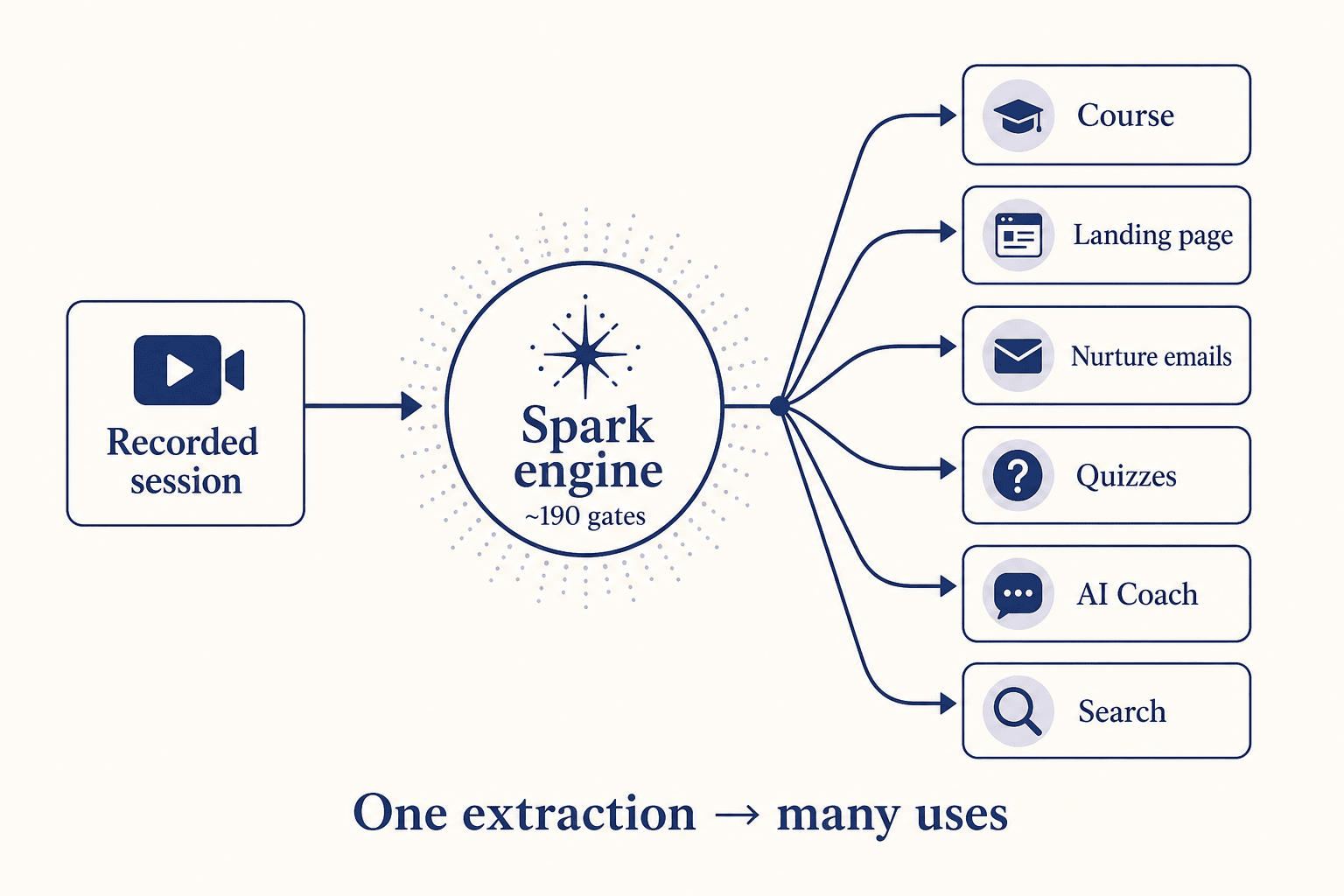
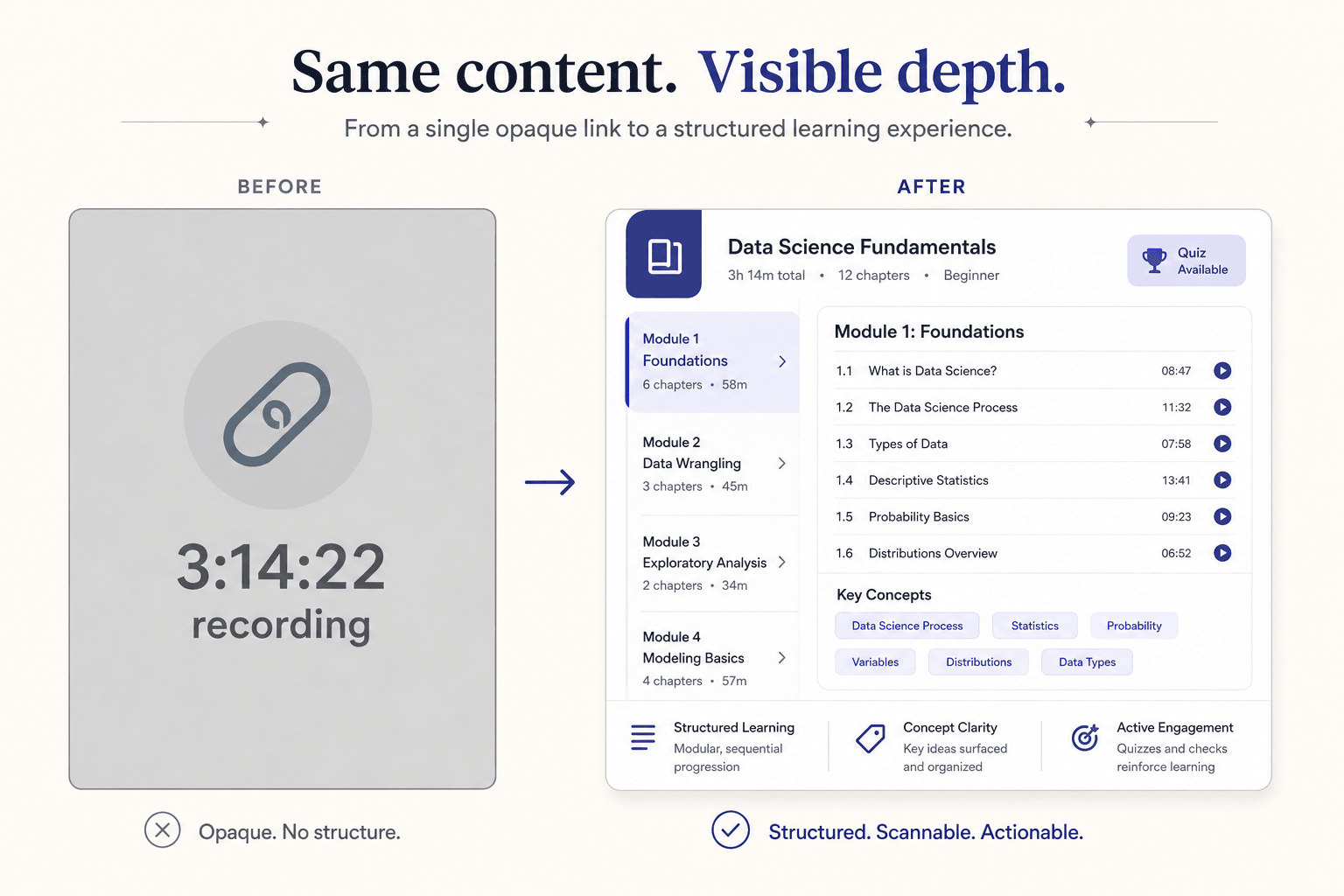
Spark is the machine that does it for them. Point it at a recording and it extracts the latent structure — chapters, slides, key concepts, summaries, knowledge checks, searchable transcripts, and semantic embeddings — and turns one raw video into structured, navigable, sellable learning. A prospective student can skim the outline in five minutes and see what was underwater — the instructor's mastery on display instead of locked behind the recording firewall.
The depth here is real, and it's our moat: a deep, heavily-audited pipeline compresses what would otherwise take a skilled human many hours of packaging work into minutes. (The specific figures from our own pilots and product work live in the appendix.) The principle to remember — and the reason this is the deepest foundation of the three — is one extraction, many uses. The same intelligence powers the course, the landing page, the nurture emails, the quizzes, the coach, and the search — across every pillar that follows. And it compounds: the more deep teaching an instructor records — each new workshop, each masterclass — the more range Spark can put on display.
5b. Spark Lite — the commerce and operations backbone NOW
Intelligence alone doesn't get an instructor paid. The second foundation is the unglamorous, essential plumbing of a real business: Spark Lite, the commerce-and-operations backbone — payments, subscriptions, country-wise pricing, plan configuration, scheduling, and the day-to-day running of a teaching practice. Many have known it as PracticeNow; it already processes real money for real instructors around the world. (How Spark and Spark Lite fit together is in the appendix.)
This is a foundation precisely because the pillars lean on it. Sales runs on it. The marketplace's enrollments settle through it. And — this is the part most people miss — it is what gives the agents in the third pillar something to act through. A model that can only suggest a price change is a consultant; a model wired into the backbone, able to actually turn on dormant country-wise pricing, is an operator. Without this backbone, the agents would be all brains and no hands.
5c. The agent-operable tool and data surface HORIZON
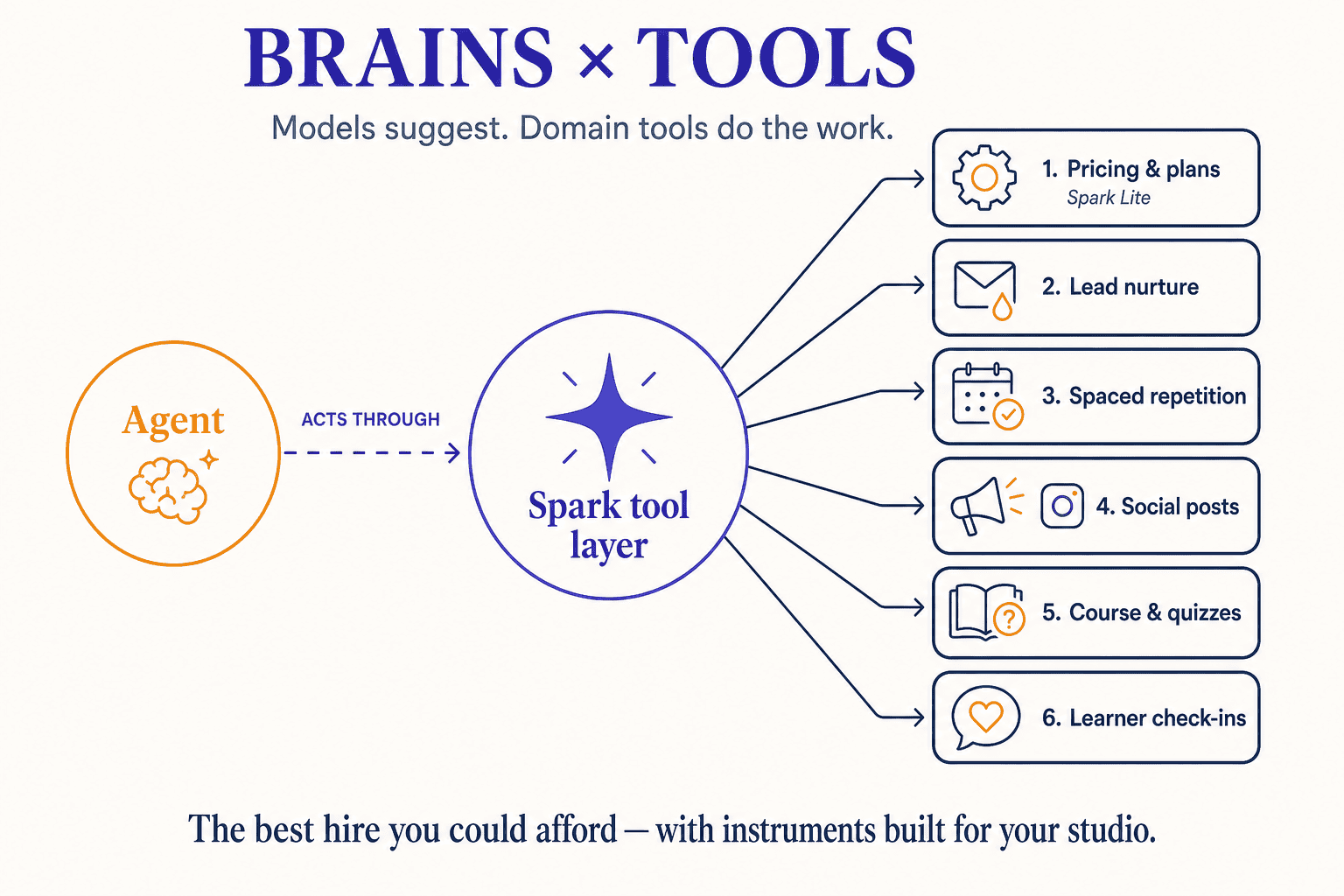
State-of-the-art models are becoming table stakes. Anyone can spin up a chatbot that suggests pricing tweaks or drafts social copy. What they cannot do, without instruments built for the job, is act: turn on country-wise pricing that has been sitting dormant in Spark Lite, schedule a nurture sequence from last month's sessions, run spaced-repetition reviews for enrolled learners, recover an abandoned checkout, refresh quizzes after a new recording lands, or post a carousel to Instagram built from Tuesday's teaching.
Those are not generic "integrations." They are tools — callable surfaces honed for online live instructors, the same segment this paper has been about all along. Each maps to real work in the pillars that follow: sales and plan configuration; nurturing and branding composed from video intelligence; spaced repetition and the AI Coach on the learner side; marketing through post creation and scheduling across social channels. More will follow the same pattern — every capability Spark builds becomes something an agent can operate, not something the instructor has to remember to click.
That specialization is the point, and it is why operability is a foundation and not a feature. A general agent with a general toolkit gives general advice. Spark's bet is narrower and deeper: tools that already understand your practice, your catalog, your learners, and your voice — because they were built on your teaching. Hard to copy, because they are built on your material, not the open web.
6. Pillar 1 — Learning tools that turn information into transformation
The first pillar is the one the learner feels directly: the tools that turn watching into actual learning. If Spark's promise is transformation, we owe it some rigour about how people actually learn — told plainly here, with the detailed evidence in the appendix. (We've drawn heavily on The Math Academy Way for how to put this into practice.)
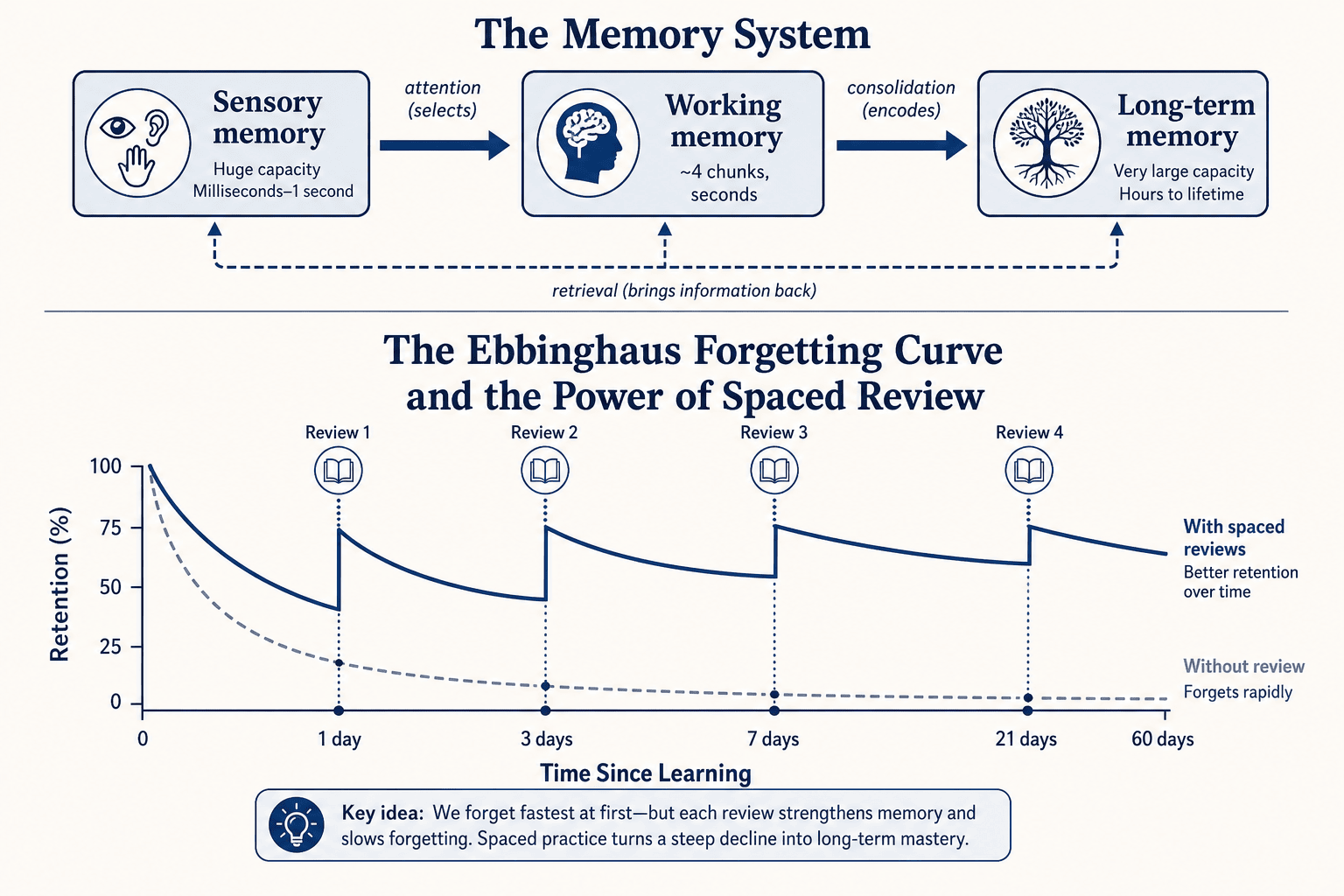
The whole picture rests on two facts about memory: working memory is tiny, and we forget most of what we don't reinforce. That dictates good teaching design, and it's what this pillar is built on:
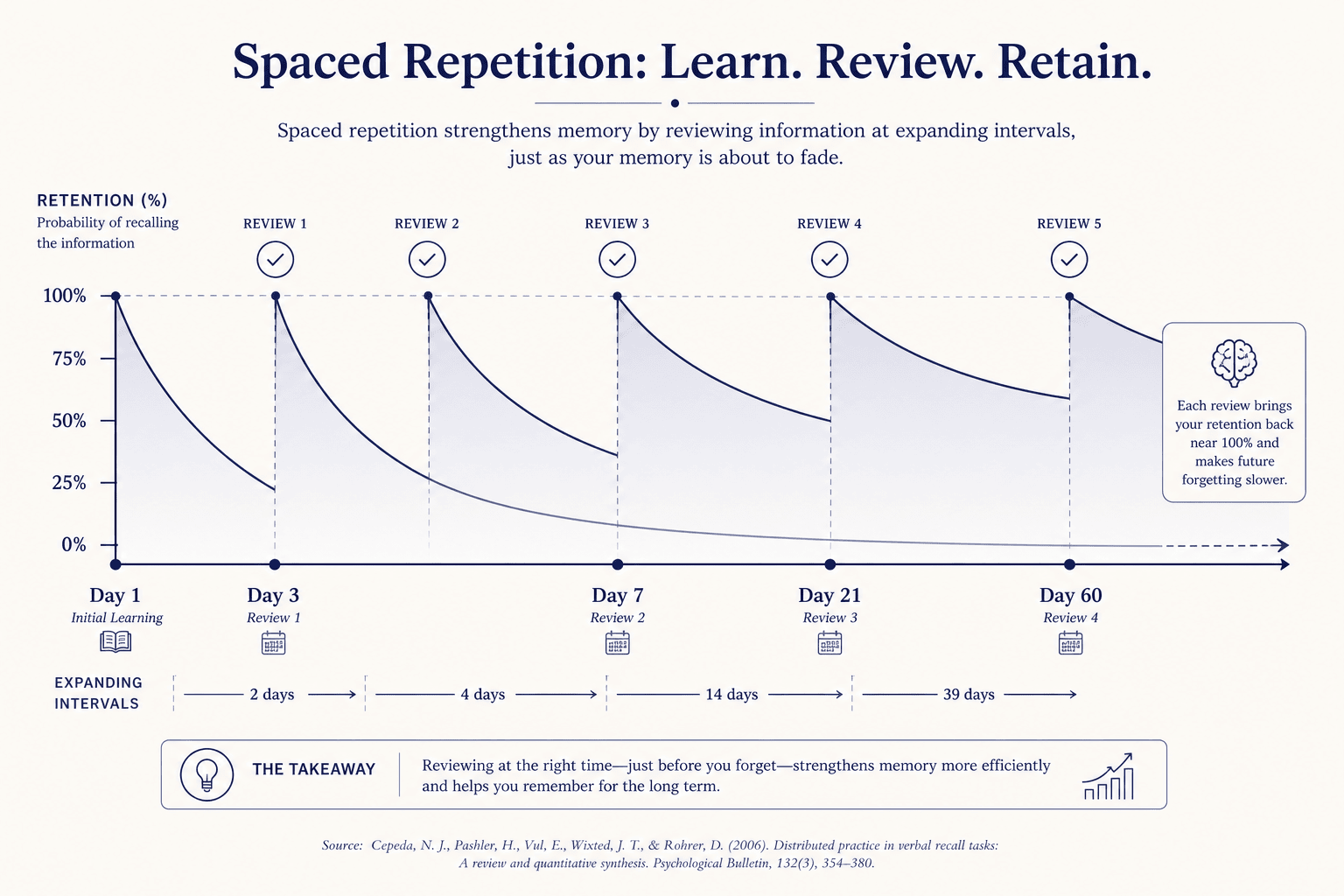
- Spacing beats cramming. Reviews spread over time hold far better than one long session → Spaced Repetition will schedule reviews of an instructor's key concepts. NEXT
- Retrieval is the learning, not the test. Being asked to recall something causes it to stick → quizzes and knowledge checks, generated from the video, aren't assessment bolted on; they're the mechanism. NOW
- Short, clean chunks. Overloading working memory leaves nothing to build durable understanding → Spark's instinct toward short (~5-minute) chapters. NOW
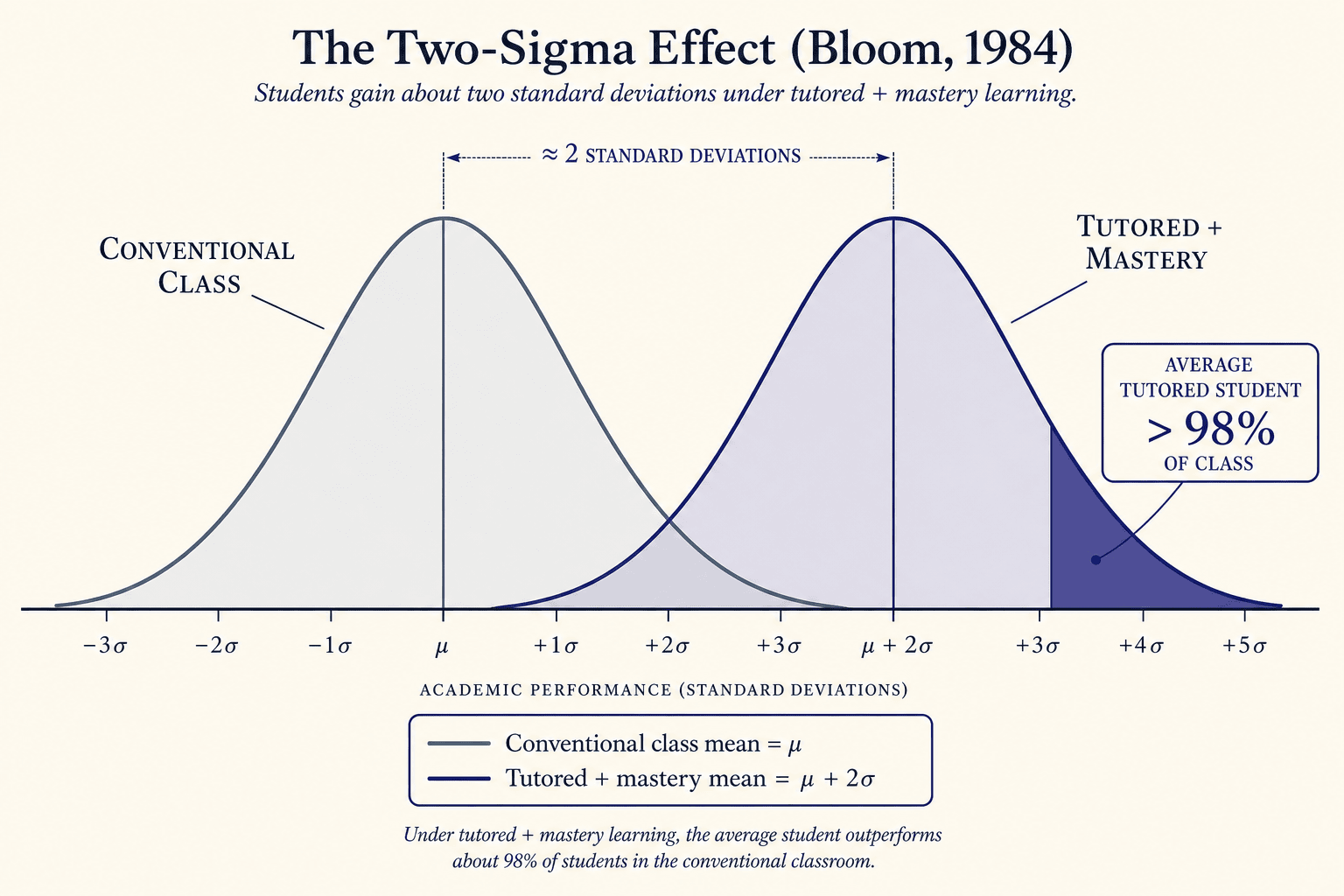
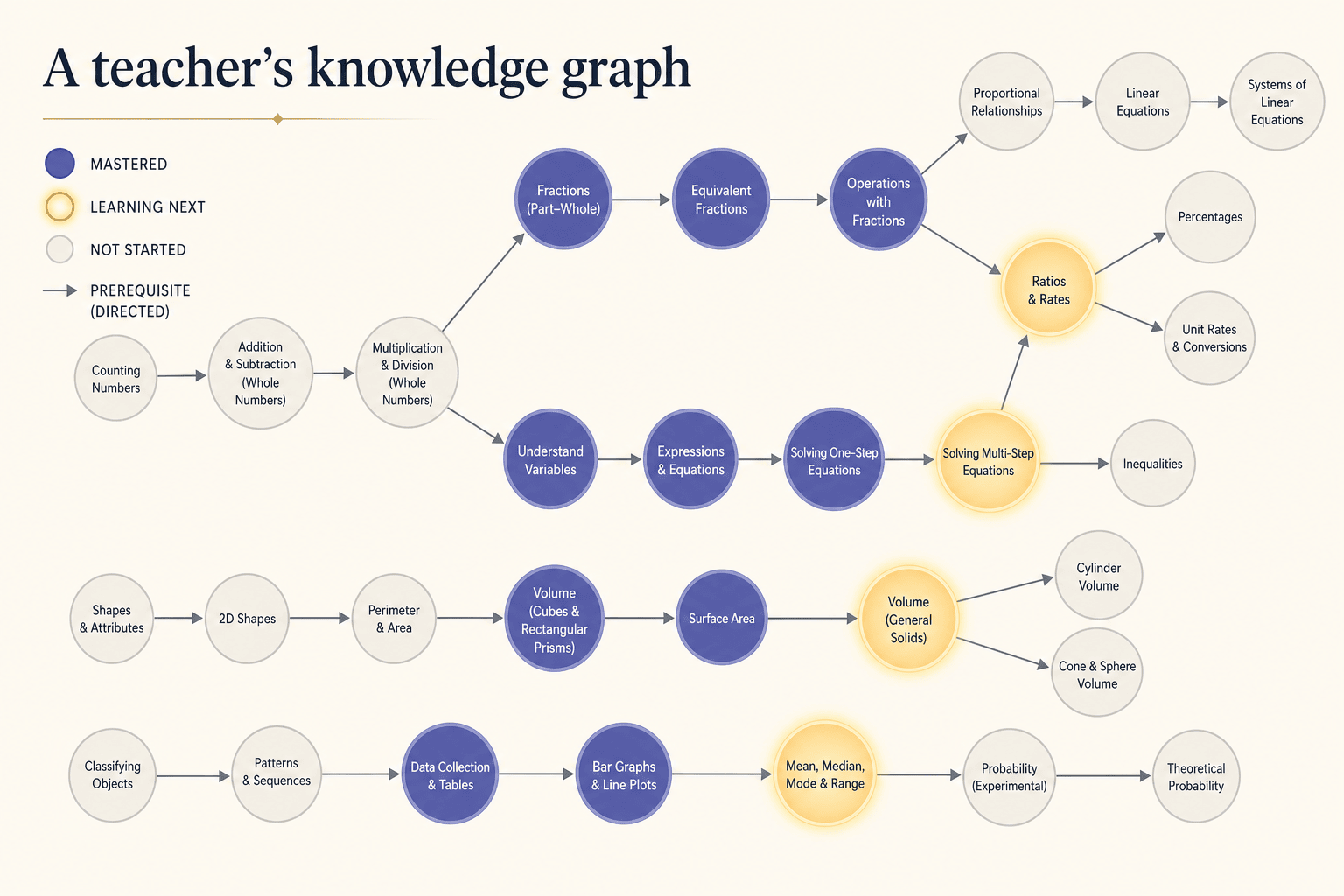
- Aim for mastery. Most students can master material given the right time and conditions, and the biggest gains go to those who were struggling → a progression and, eventually, a per-instructor knowledge graph that lets learners advance as they master. HORIZON
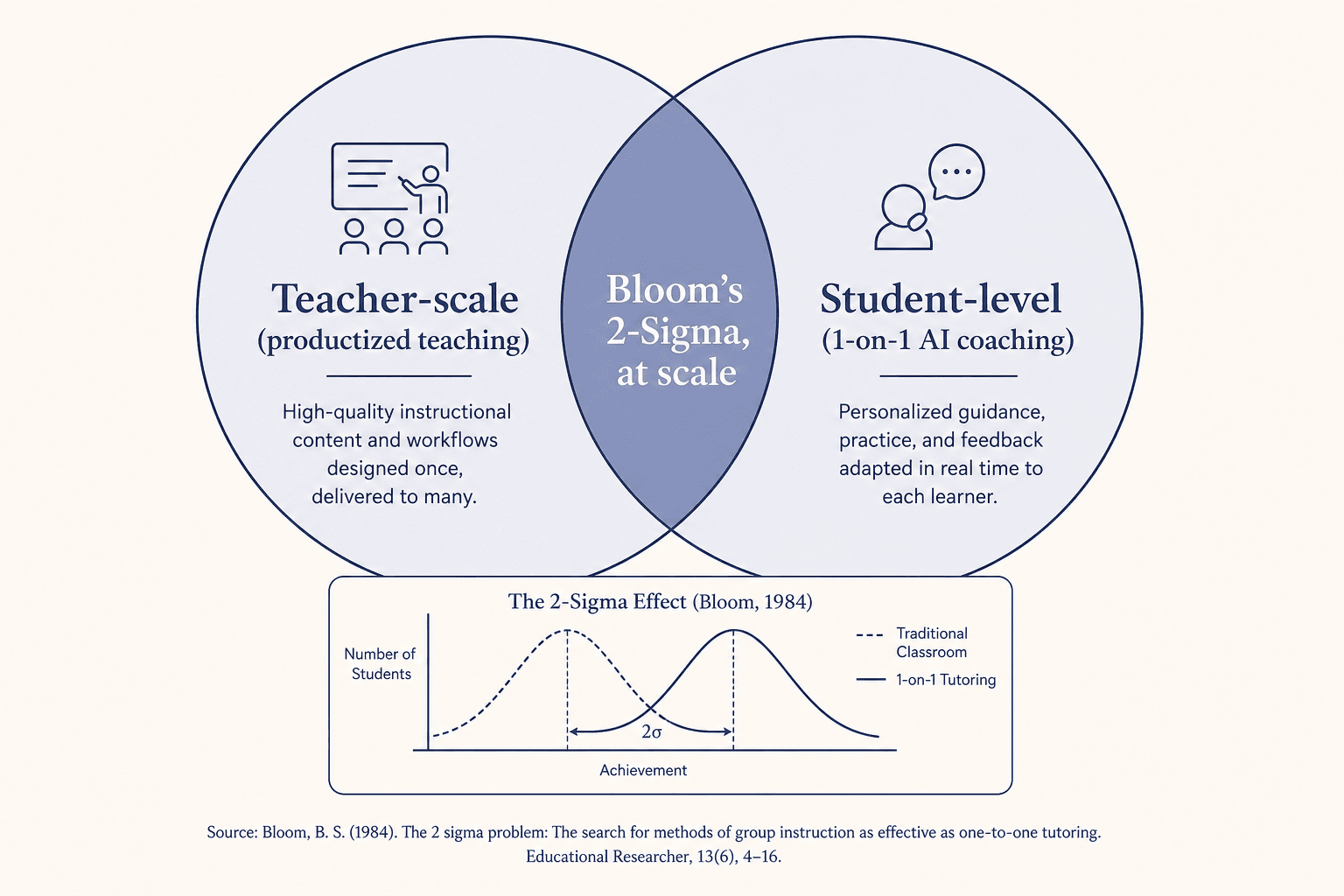
The prize is personalization at scale. For most of history, the best education — a great tutor, one-on-one — was also the most expensive and least scalable thing in the world. Spark applies AI at two levels: instructor-scale personalization that productizes an instructor's teaching beyond their time-zone-bound hours, without losing their voice (this is shipped, and it's how an instructor breaks the Word-of-Mouth Ceiling), and student-level personalization — an AI Coach that tailors guidance to each learner, which is what we're building toward. The research on tutoring is encouraging: one-to-one guidance, done well, produces large gains, and AI is the first technology that makes its economics approachable for everyone. The exact magnitude is debated; the direction is not. (The effect sizes, and our honesty note about them, are in the appendix.)
7. Pillar 2 — A marketplace and communities of humans
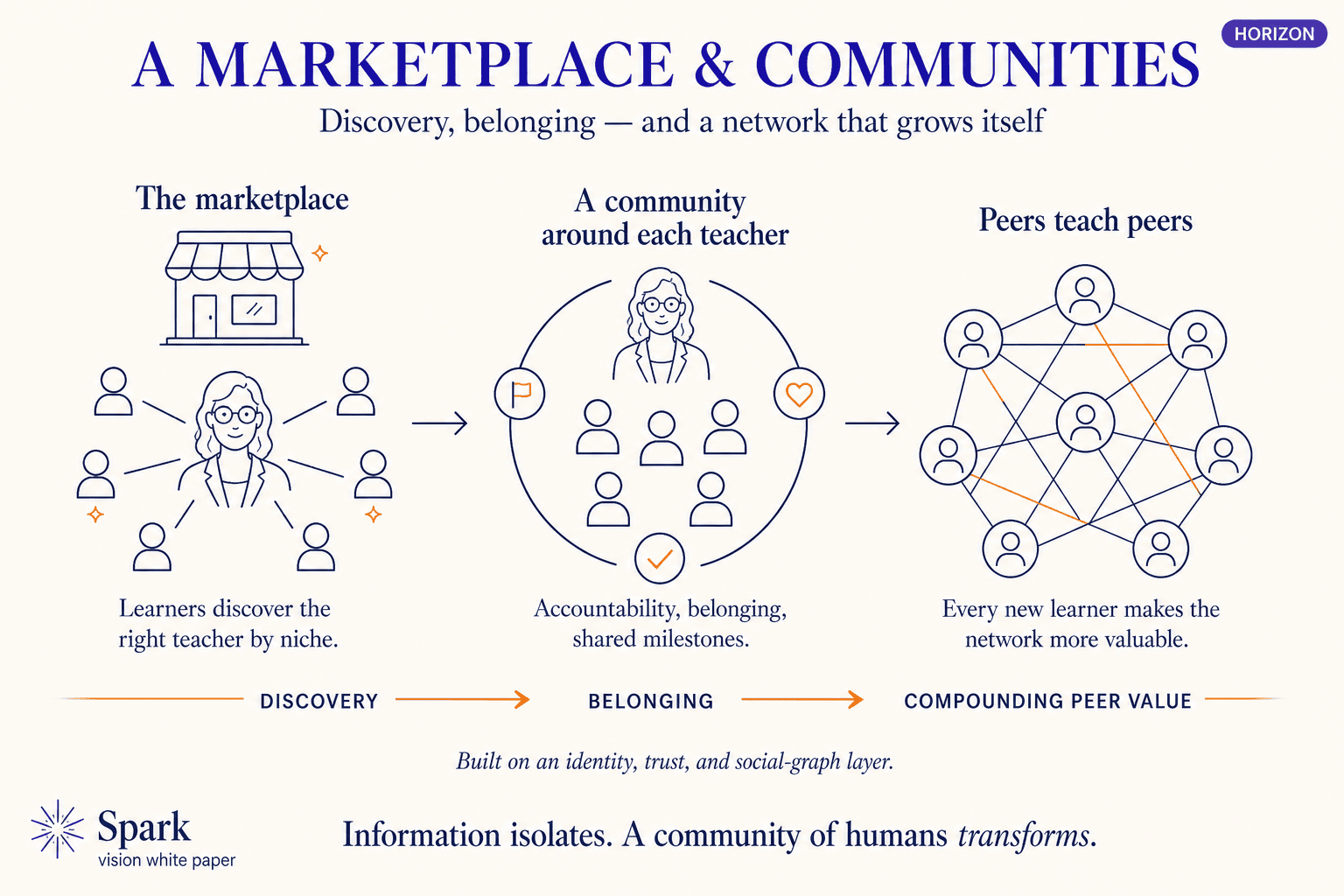
The second pillar is the most ambitious, and the furthest out. HORIZON It is also the one that strikes directly at the two traps from the start of this paper: the Respect Gap and the Word-of-Mouth Ceiling. An instructor can be brilliant and still be alone — invisible to the learners who need them, and surrounded by no one. This pillar fixes both halves: being found, and being held.
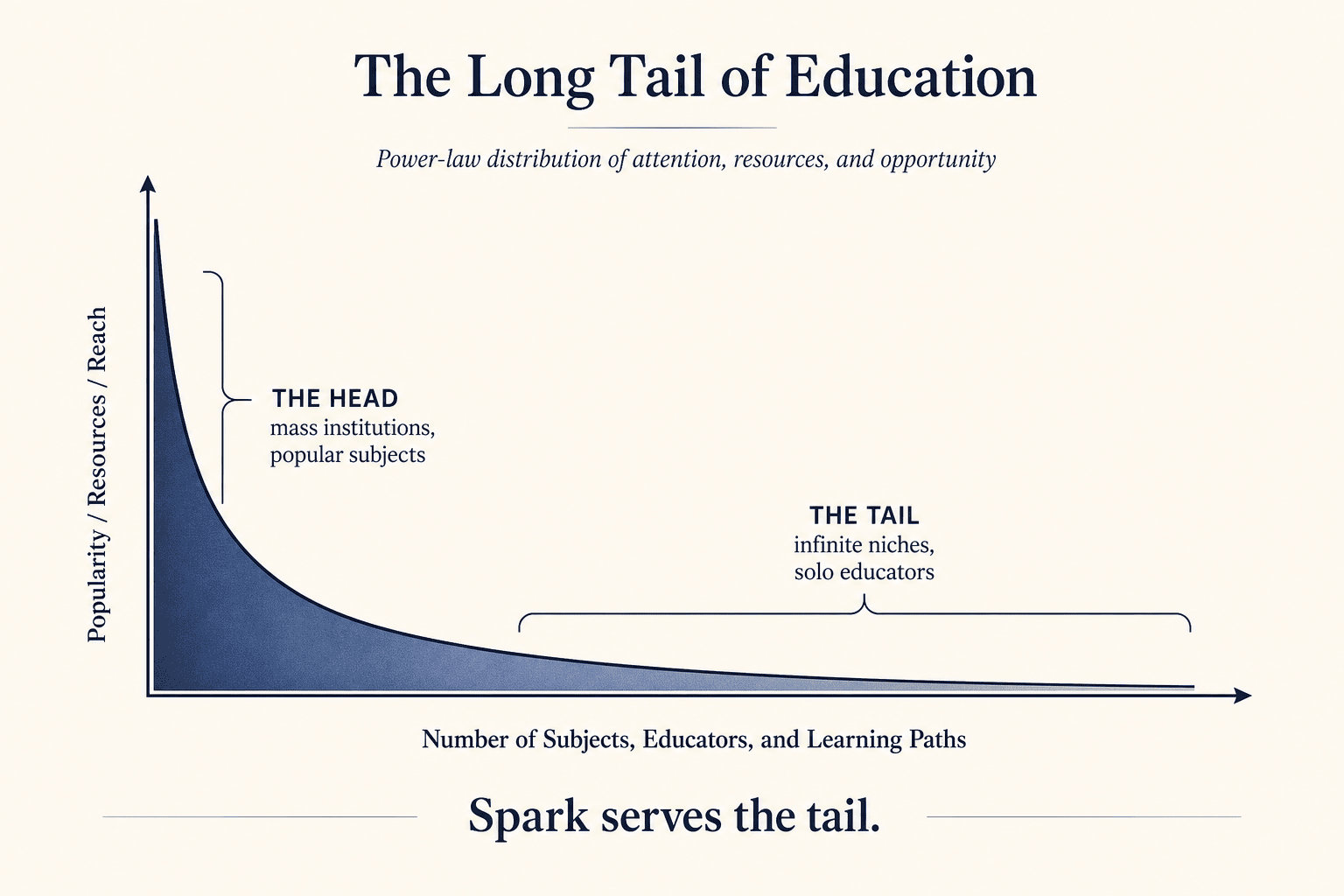
Being found. Today a great instructor's only real channel is word of mouth, which plateaus. A marketplace changes the math: learners discover instructors by niche, and the long tail of expertise finally meets the demand the internet makes findable. (The economics of that long tail are in the appendix.)
Being seen — depth made visible. Discovery only matters if, once found, an instructor's depth is visible. Recall the Respect Gap: an instructor's brilliance is the mass below the waterline, invisible to anyone who hasn't sat in the room. The fix is communication — making that depth land. When you turn rambling recordings — the everyday classes and the occasional deep workshop alike — into a structured course outline (modules, chapters, concepts laid out at a glance), you make an instructor's depth concrete and credible in a way words never could. This is what it means to showcase your mastery — not a claim about it, but the thing itself, laid out to be browsed. The deep material that used to surface once and vanish now sits on display as part of the instructor's visible range. NOW
A prospective student who spends five minutes inside that structure has their perception flipped: from "another instructor, I guess" to "oh — this person has real range and depth." Two instructors told us versions of the same thing: "I didn't know I'd covered so many topics until I saw it laid out," and from a learner, "I didn't know there was so much to learn about this until I saw the course." That moment of pleasant surprise is the Respect Gap closing in real time. (The communication principle here is Chip and Dan Heath's "Made to Stick"; the framework note is in the appendix.)
Being held — a community of humans. Discovery brings learners in; community is what keeps them and transforms them. Most of the transformation layer from section 3 — accountability, belonging, the encouragement that carries you when motivation dips — is not something one instructor can manufacture alone, and it is exactly what plateaus today. So the next move in this pillar is to catalyze a community of humans around each instructor: a place where milestones become shared identity, and where learners are supported not only by the instructor but by one another.
That last part is the quiet multiplier. When learners interact with each other — answering questions, sharing progress, holding one another to a practice — each new member makes the community more valuable to every other member. The instructor is no longer the single point through which all value must flow. This is the structural cure for isolation: not a bigger audience for one voice, but a network of humans who create value for each other, with the instructor at the center.
Two honest notes. First, making this real needs its own groundwork — verified identity, signals of quality a learner can trust, and the connections between people that turn a list of names into a community. We are building toward it, not claiming it has shipped.
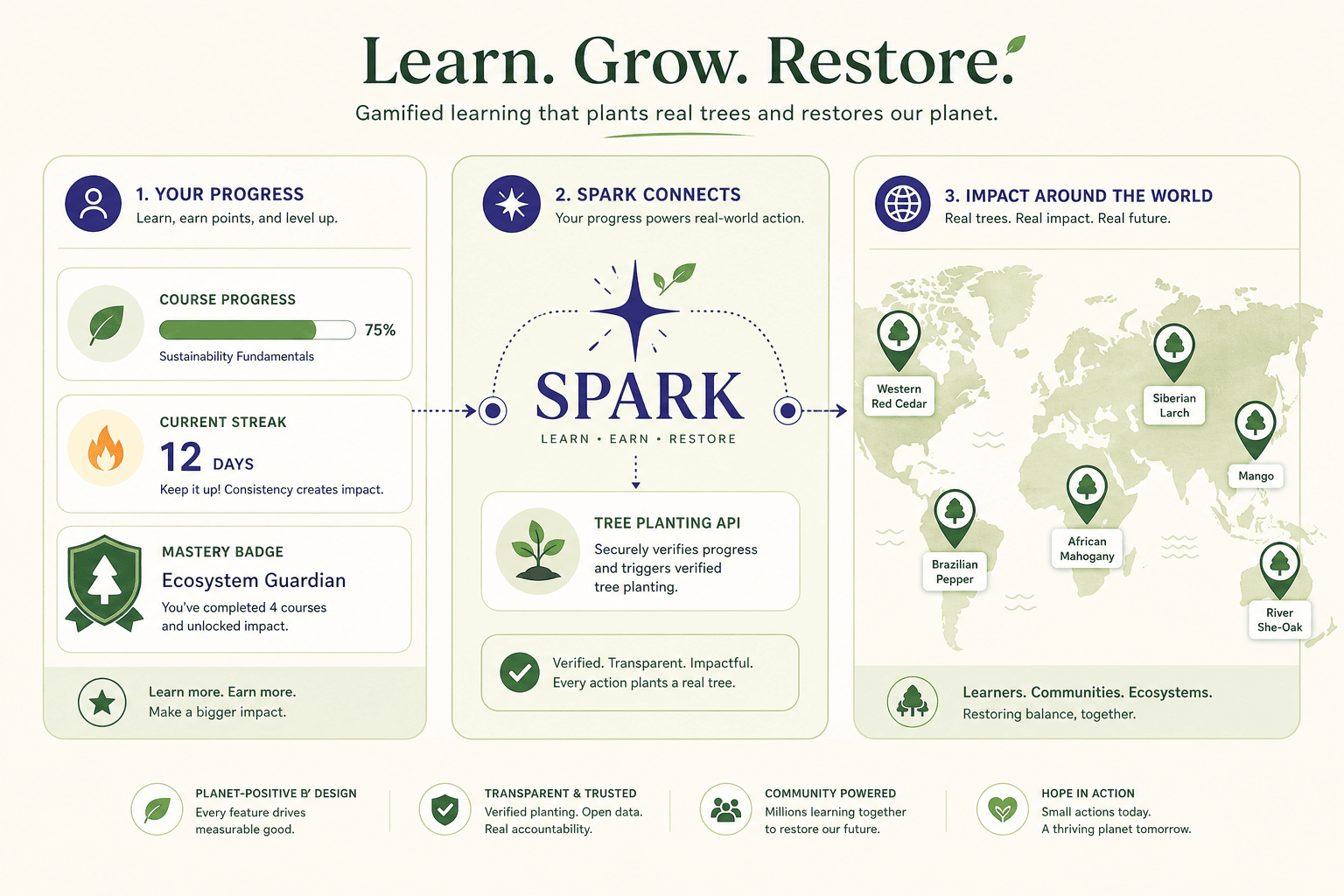
Second, one idea we hold loosely as an aspiration. We'd like gamification to mean more than points and badges. We're drawn to tying real learning milestones to real trees planted in the real world, through reforestation-as-a-service APIs — services like DigitalHumani , Tree-Nation , and Ecologi make this straightforward — so a learner's private growth becomes a visible, shareable, planetary good rather than confetti that means nothing tomorrow. We hold this loosely, as an aspiration, not a proven mechanism. HORIZON
8. Pillar 3 — A 24/7 team of AI agents that runs the business
The third pillar is what makes the first two survivable for one person. HORIZON Most solo instructors are brilliant at the craft and accidentally running a business they were never trained to run — stuck working in the business, never on it. (This is Michael Gerber's E-Myth diagnosis; the framework note is in the appendix.) The cruel part is that the levers to grow are usually already there — pricing, country-wise pricing, subscriptions, plan configuration, scheduling, follow-ups — but the instructor never has the time, training, or headspace to pull them.
So the horizon is this: with Spark and Spark Lite exposed as tools an agent can operate — the agent-operable surface from the foundations — stand up a small team of AI agents that work on the business, 24/7, on the instructor's behalf, with access both to the data inside Spark and to Spark itself as a set of tools they can act through.
Picture an instructor waking up to a short note: overnight, the operations agent tuned pricing and turned on country-wise pricing that had been sitting dormant; the learner-delight agent spotted three students drifting and nudged them, and flagged one who needs a human word; the marketing agent turned last week's recording into a set of posts and scheduled them. And behind those three, a growing team — enrollment, course-building, community, insights — each handing context to the next, all reporting up to the instructor, who stays in command.
The point isn't an instructor replaced by bots. It's the opposite: the business gets handled and reported on, so the instructor is freed to do the one thing only they can do — teach, and transform. Everything here is built from the instructor's own material, in the instructor's own voice.
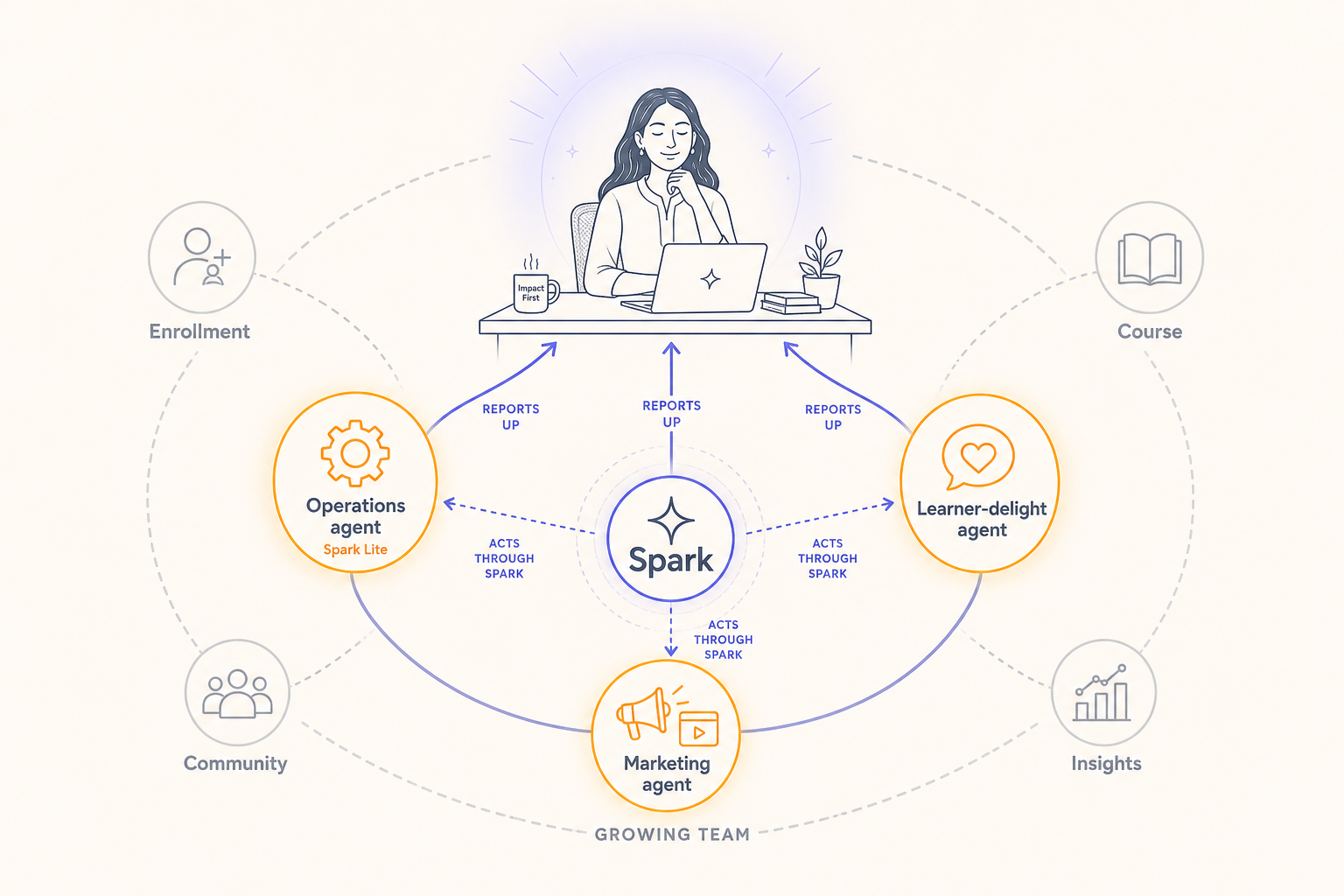
What makes a team worth having is the handoff. Put the pieces together and the value sharpens: the brains any instructor would want to hire, wired to tools only this category of business needs, coordinated as a team that hands context to the next agent. Picture Tuesday's session processed overnight: the marketing agent drafts posts from it; the operations agent enables a short promo on the plan that fits; the learner-delight agent watches who engages and who goes quiet. No single bot doing everything — a handoff chain, all reporting up to the instructor.
There is a second kind of value here, easy to miss because it is not about labour saved.
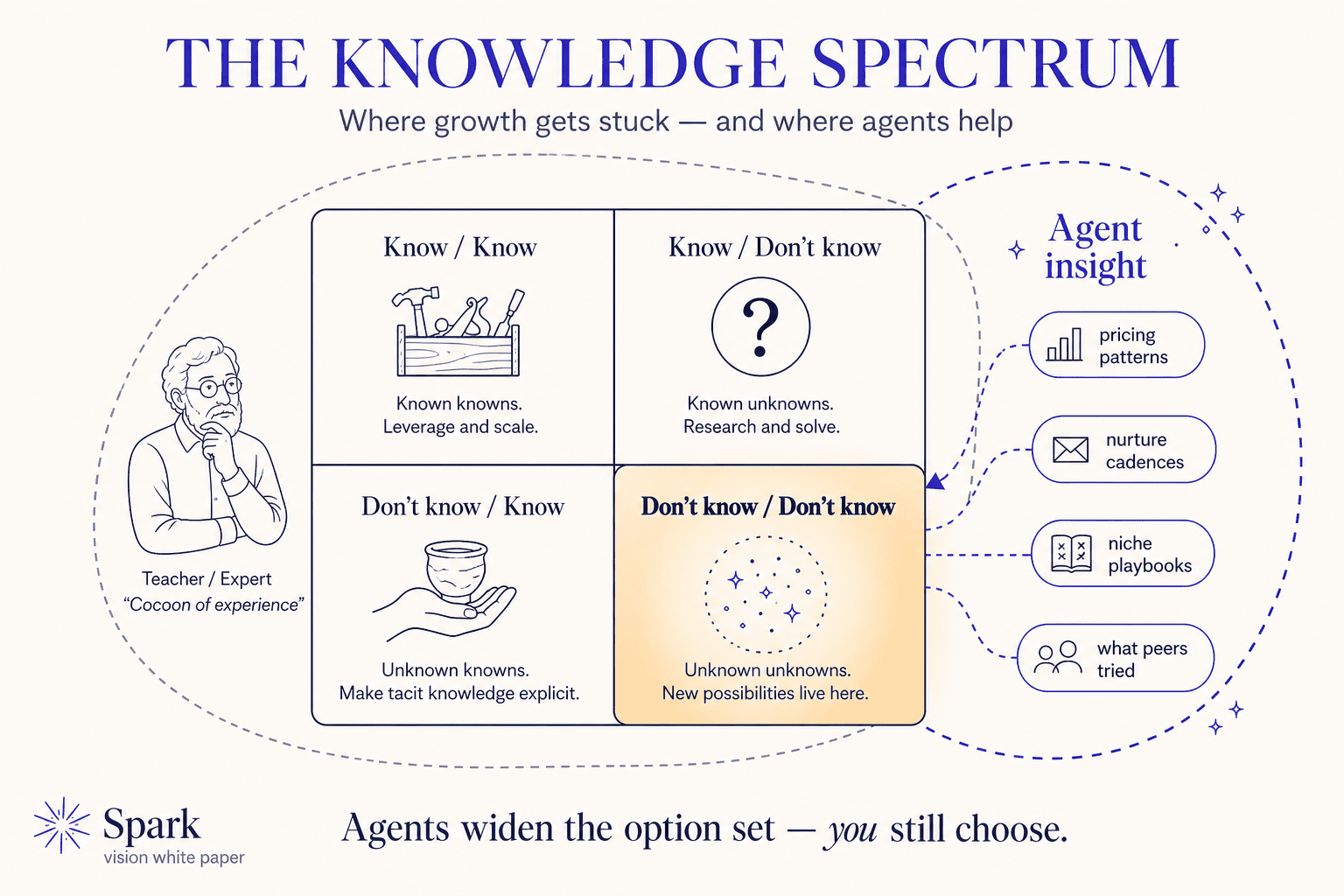
Most of us move through a simple map of knowing. There is what we know we know — our craft, our students, our material. What we know we don't know — the skill we have been meaning to learn, the feature we have not turned on yet. What we don't know we know — tacit judgment built over years of teaching that we apply without naming it. And then a fourth quadrant, the uncomfortable one: what we don't know we don't know. The pricing experiments we never considered. The nurture cadence we never saw modeled. The cohort structure that would suit our niche. The mental patterns successful instructors in adjacent fields already use.
That fourth quadrant is where growth stalls. Not from lack of intelligence — from bounded context. Same referrals, same platforms, same peers, same habits formed over a career. A cocoon, not a cage: comfortable, familiar, and blind to options that were never in view.
Agents change that equation in a way a chat window does not. Yes, they will run the tools described above. They can also surface what was missing from the map: playbooks that worked for instructors like you, benchmarks for your niche, experiments worth trying next — grounded in your own data where possible, widened by a pattern library larger than any one instructor's lived experience. You still decide. The option set gets wider.
The marketplace pillar was about making your depth visible to the world. This is about making possibility visible to you — so the business can grow in directions your cocoon never showed you, without turning you into a full-time operator. The instructor stays in command; the blind spot shrinks.
9. Why now — the Great Convergence
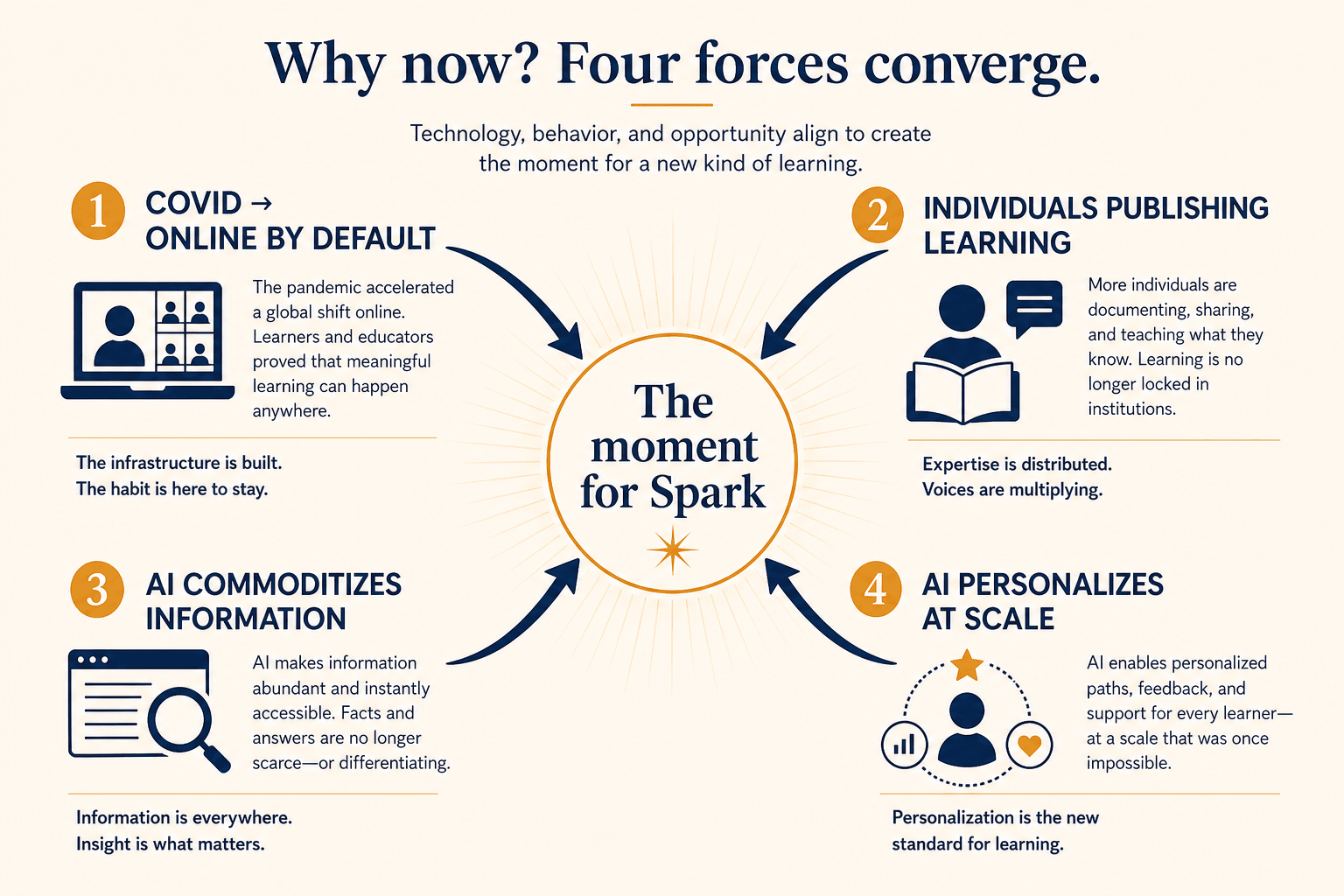
A fair question by now: why is all of this buildable today and not five years ago? Because two conditions that never used to exist together have finally arrived in the same window.
A decade of teaching is already recorded. The pandemic pushed teaching and learning online, and the habit didn't reverse when classrooms reopened. Individuals — not just institutions — now publish structured learning at industrial scale. The raw material Spark needs is already sitting on instructors' hard drives, most of it gathering digital dust. (The numbers behind this shift are in the appendix.)
AI is finally capable of the hard part. The same technology that makes information abundant can, for the first time, deliver the thing that used to be the most expensive in all of education — individual attention — to many learners at once. The transformation layer this paper is built on only became buildable once AI crossed that line. (We present "commoditization" as our interpretation of the evidence, not a settled finding.)
Neither force alone is enough. A decade of recordings with no way to turn them into transformation is just more content behind the firewall; capable AI with nothing authentic to stand on is just another generic tutor. Together — the raw material and the tool, arriving at the same moment — they are the convergence Spark was built for.
10. The flywheel — how the three pillars compound
The three pillars are not a menu; they are a system, and the system has a shape. Most teaching businesses leak: strangers arrive, a few convert, the rest fall through. The way out is to stop running a funnel and start running a factory — a system where each stage feeds the next in sequence, every stage observable and improvable. (This is Ash Maurya's Customer Factory; the framework note is in the appendix.)
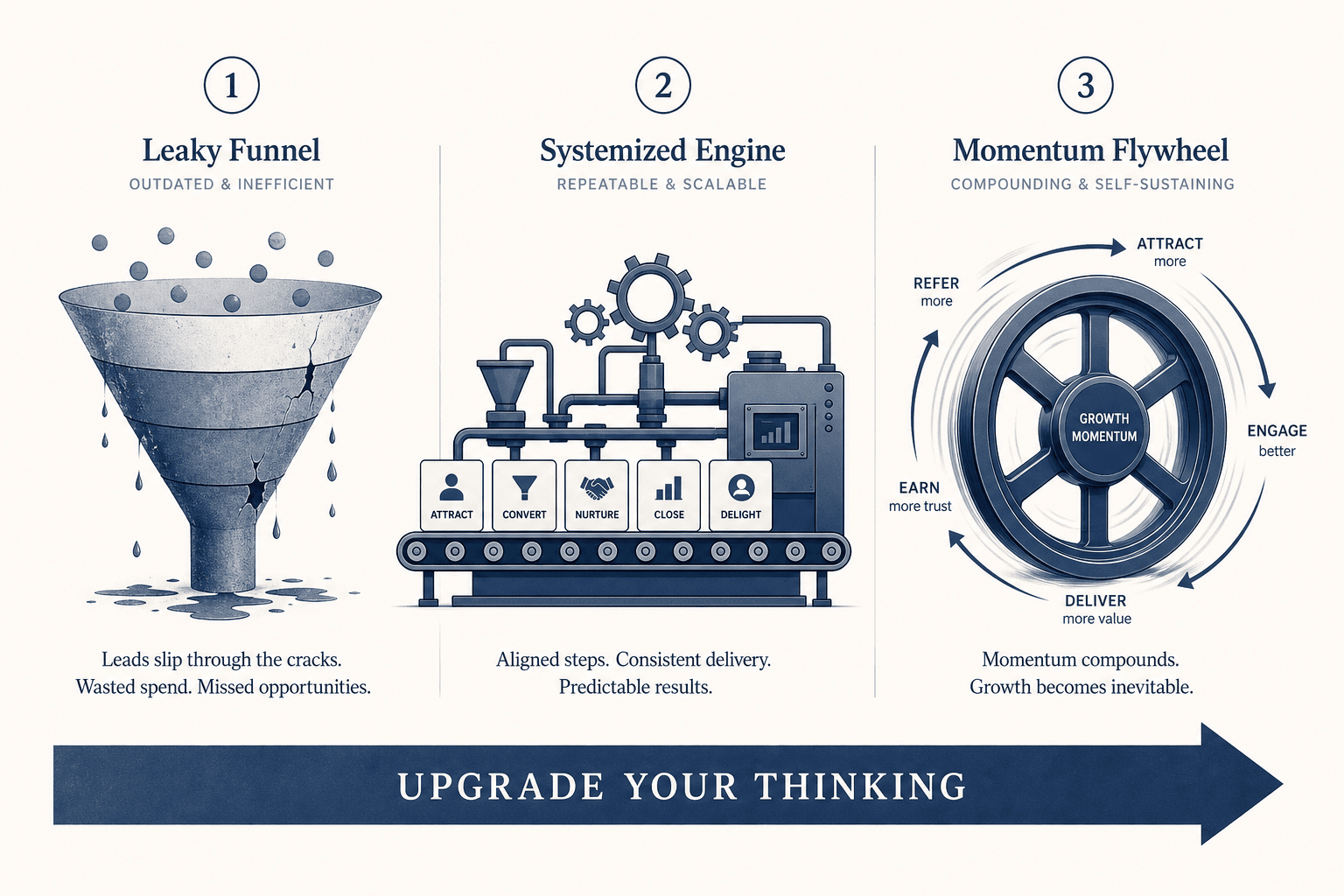
Seen up close, the three pillars break into the working stations operators recognize. Discovery, branding, nurturing, and community are the marketplace-and-communities pillar; spaced repetition and the AI Coach are the learning-tools pillar; sales runs on the Spark Lite backbone; and the agent team is the operator that runs every station. Same content extracted once, powering all of them — the foundations underneath the line.
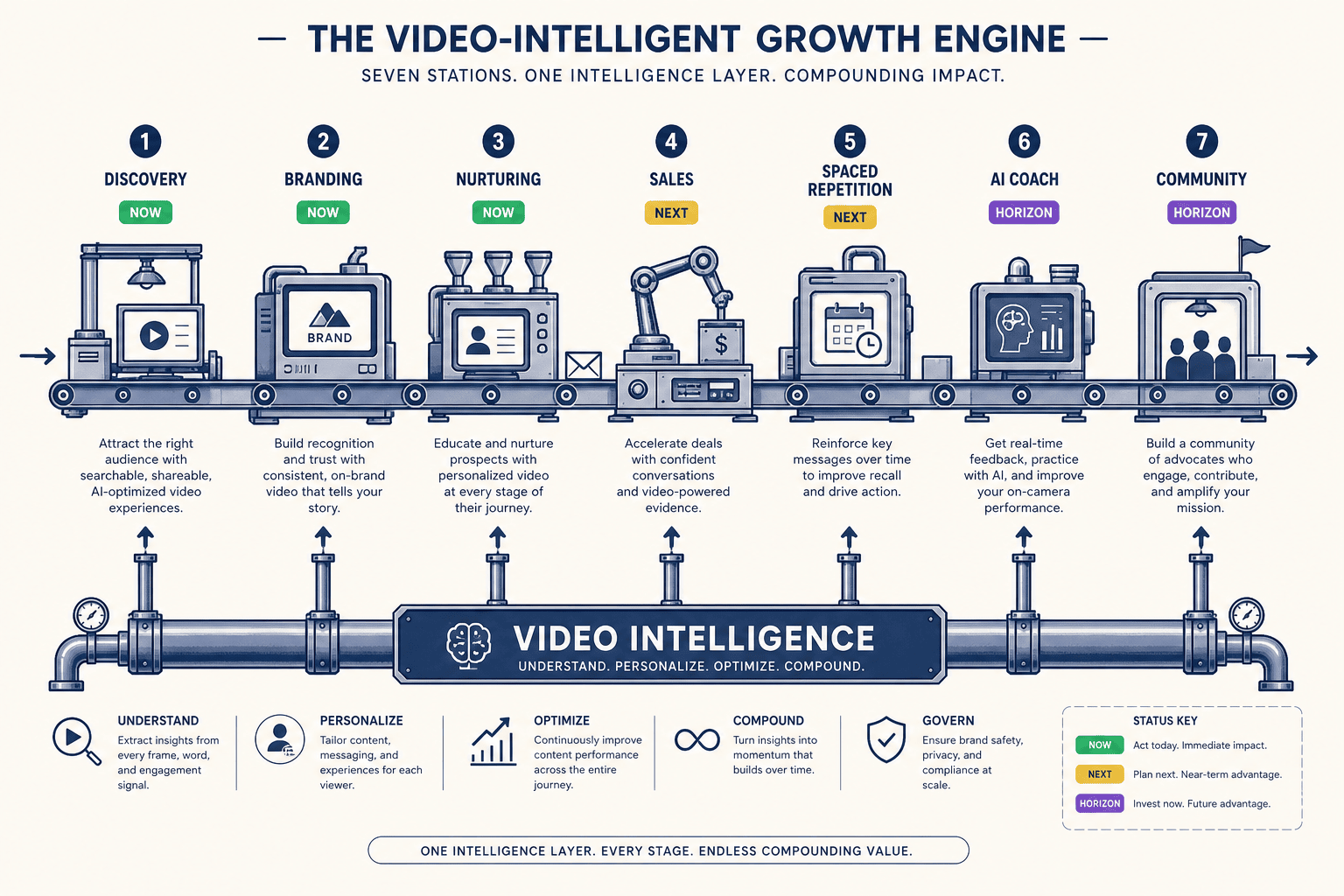
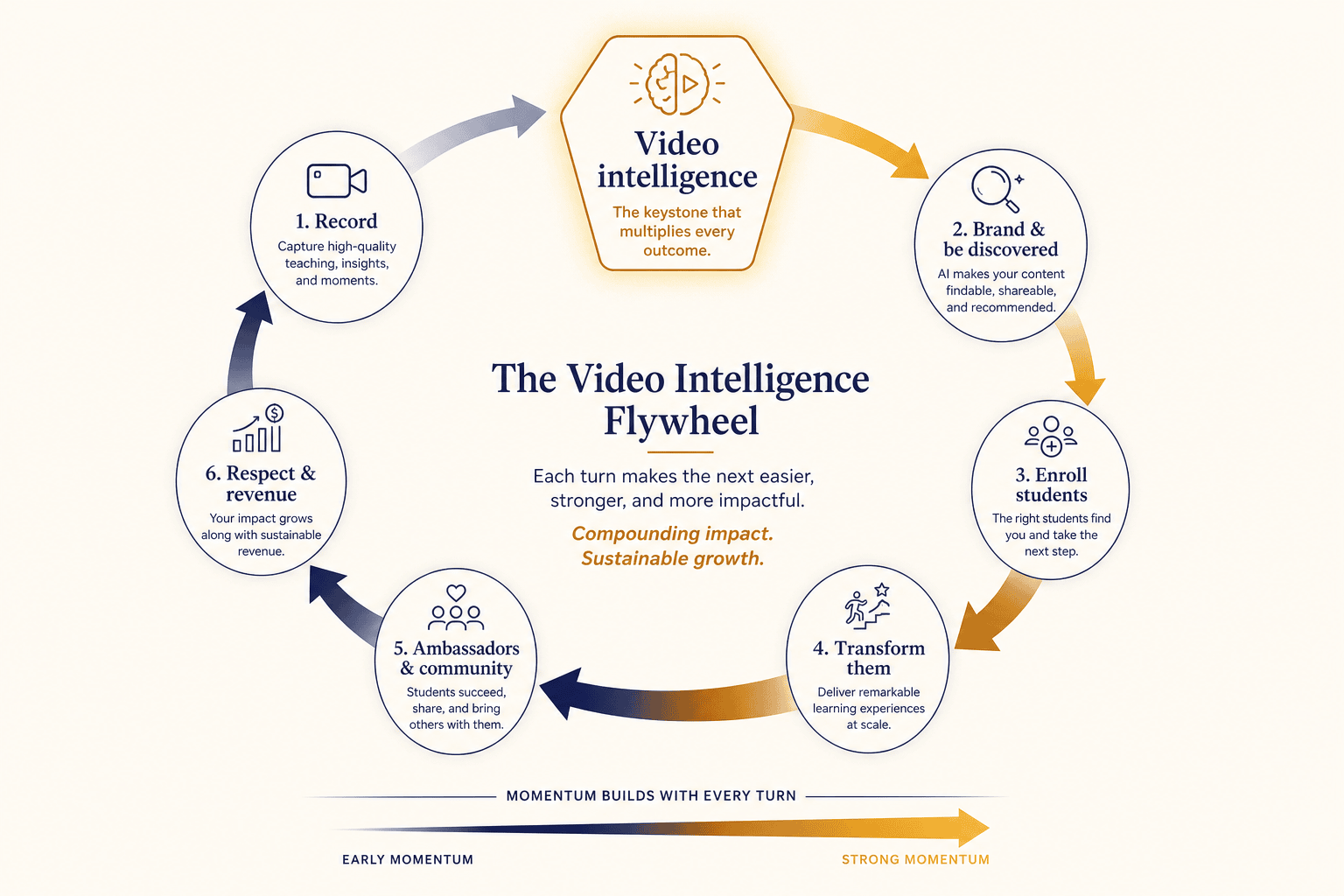
Now lay those stations in a circle and the line becomes a loop — a flywheel. (Jim Collins's image; framework note in the appendix.) More teaching recorded → richer video intelligence → better discovery, branding, and nurturing → more students → more transformed students who become brand-ambassadors and community members → more respect and more revenue for the instructor → which funds and motivates more (and better) teaching. And around again, faster each turn.
The keystone of the wheel is the foundations — video intelligence above all — because they make every other push easier. The compounding output is the thing we set out to create on page one: respect, community, and a real living for the instructor. This is the structural answer to the Word-of-Mouth Ceiling: word of mouth, engineered into a flywheel, no longer plateaus — every transformed student adds torque.
11. Where we are, and an invitation
Vision papers earn trust by being clear about what's real. Here is the trifecta, sorted by status.
- NOW — shipped / in live pilot. The video-intelligence pipeline and the Spark Lite commerce backbone (the two live foundations); automatic course generation; the structured course player; the AI tutor; quizzes and knowledge checks; and real teaching content processed in live pilots. (Figures in the appendix.)
- NEXT — in build / near-term. More of the learning-tools pillar: drip nurturing from an instructor's own content; spaced-repetition scheduling; a deeper, more contextual AI Coach.
- HORIZON — vision / roadmap. The marketplace-and-communities pillar — discovery, full community, and learner-to-learner networks; per-instructor knowledge graphs; the 24/7 agent team and the agent-operable tool and data surface beneath it; strategic pattern surfacing for the business; planet-positive gamification; and longer-term, AI-avatar teaching experiences.
Strip everything back and the destination is simple: Spark wants to be the home — the operating system — for the world's solo instructors, and through them, a force that closes the Respect Gap at scale. The shape of that operating system is the trifecta — learning tools that transform, a marketplace and communities that end the isolation, and a team of agents that runs the business — all built from the instructor's own work, all standing on the same foundations. Imagine reversing the inversion this paper opened with — a world where teaching is among the most respected and best-paid callings, because the people who do it can finally make their depth visible, reach the students who need them, and run a thriving practice without burning out on the acquisition treadmill.
The horizon keeps extending — toward AI-avatar instructors and something like a personal, on-demand university for every learner. We hold those loosely, as aspirations. The core conviction we hold tightly: information is becoming free; transformation is becoming priceless; and the people who deliver transformation deserve an engine worthy of their gift.
This paper began with an instructor whose worth the world couldn't see, and a student who couldn't stop asking why. If you're an instructor, Spark is being built so your brilliance stops gathering dust behind a recording firewall — so the depth you already have becomes visible, respected, and a living. The move that gets you there is the one this paper keeps returning to: turning your teaching into a product that stands and scales beyond your live hours, without losing the depth or your voice. That is how the Word-of-Mouth Ceiling finally breaks — and Spark is the bridge to it.
Said in a single line, that is what Spark is for you: the fastest way to showcase your mastery online.
Onward.
Appendix — foundations
If you read this far, you probably care how the argument holds up under scrutiny — not just whether it resonates. This appendix is for that read: the wider context behind "why now," the studies and effect sizes behind the learning-science claims, the frameworks we use when we make product and business calls, what we have actually measured so far, how Spark and Spark Lite fit together, and a partial list of craft domains where mastery tends to stay invisible. None of it is required to grasp the vision; all of it is here so nothing important is hand-waved.
A1. Why now — the wider picture, in numbers
This section is not about where you sit on a curve. It is about why the conditions for a serious teaching business have changed — and why a tool that respects craft can matter at scale.
Four forces converge on this moment.
The world moved teaching online — and stayed. The pandemic produced the largest disruption of education in history; at its April-2020 peak it affected 1.6 billion learners — about 94% of the world's students — across more than 190 countries, alongside over 100 million teachers. The classrooms reopened; the habit of teaching and learning online did not reverse.
Individuals became publishers of structured learning. On the major course platforms, the share of new, non-university courses jumped sharply in a single year (on Coursera, 31% → 39% from 2020 to 2021), as structured online learning reached ~220 million learners. Global EdTech and digital-learning spend was projected to reach roughly $404B by 2025, growing ~16% a year. (Projected figure; forecast made ~2020–21.) These figures are signals of growing demand for serious async learning — not a prompt to chase volume for its own sake.
AI is commoditizing information. Information goods are expensive to produce once and nearly free to reproduce ; generative AI extends that near-zero marginal cost to generation itself, with measured knowledge-work productivity gains around ~14% (specific to customer-support agents in the cited study).
The tail is now an economy. Independent-creator earnings follow a steep power law — researchers analyzing more than 100,000 (social-media) creators found a power-law exponent of roughly α≈2, closer to the distribution of wealth than of labour income — and Goldman Sachs estimates about 96% of creators earn on the order of ~$1,000 a year while only ~4% are full professionals. The creator economy is heading toward roughly half a trillion dollars with ~67 million creators ; the professional coaching industry alone counts well over 100,000 practitioners and several billion dollars in revenue. (Note on scope: "creator" is broader than "instructor"; we use these as umbrella figures, not instructor-specific counts.) A tiny head; an enormous, under-monetized tail — full of brilliant instructors. What matters for craft-led instructors is discovery and reach: depth that never surfaces cannot be respected.
A2. The evidence in depth — learning science and effect sizes
The memory model. Information flows from sensory memory into working memory, and only some consolidates into long-term memory. The bottleneck is working memory: Miller's "seven, plus or minus two" was later revised to a true capacity of about four chunks when rehearsal is blocked. What we don't consolidate, we lose: Ebbinghaus's forgetting curve showed retention dropping steeply soon after learning , faithfully replicated in the modern era ; forgetting also appears to be partly an active, sleep-linked process.
The interventions. Distributed practice beats cramming, with the ideal interval growing as the retention horizon grows ; retrieval practice (testing) causes learning, with the advantage growing at longer delays ; interleaving beats blocked practice on delayed tests ; and respecting cognitive load is what lets durable schemas form.
Personalization and the two-sigma question. Bloom found students tutored one-to-one with mastery techniques performed about two standard deviations better than conventionally taught students — the average tutored student outscoring 98% of the classroom group. Later work pegs human tutoring at around d≈0.79 and intelligent tutoring systems close behind at d≈0.76. A 2025 randomized controlled trial (single institution, N=194, purpose-built GPT-4 tutor) found students learned more than twice as much, in less time, than in an active-learning class.
Honesty note. Mastery learning on its own typically yields ~0.5–1σ, not the full two sigma; the headline 2σ requires the full stack of tutoring plus mastery, measured on small samples. We aim at the ceiling while reporting the floor. And the AI Coach that would deliver student-level personalization is NOW NEXT, i.e. partly still being built — the evidence supports the direction, not a claim that Spark already does this at scale.
A3. The frameworks we lean on
Spark's own ideas carry the argument; these established frameworks are the shoulders we stand on, one line each.
- The Golden Circle (Sinek) — start with why, then how, then what; people buy why you do it.
- Made to Stick / SUCCESs (Heath & Heath) — sticky ideas are Simple, Unexpected, Concrete, Credible, Emotional, and Story-shaped.
- The E-Myth Revisited (Gerber) — most small businesses are run by Technicians; the way out is a turnkey system, not founder presence.
- The Customer Factory (Maurya) — see the business as a system that converts strangers into loyal customers, every stage observable and improvable.
- The Flywheel (Collins) — a heavy disc, hard to turn at first, where every push compounds until momentum does the work.
- The Long Tail (Anderson) — when distribution and discovery are cheap, the aggregate of niches can rival the head.
A4. What we have measured ourselves
These are figures from our own pilots and product work — accurate as of the latest available data and to be reconfirmed against live data before publication.
- The pipeline runs through on the order of ~190 audited automation gates, compressing what would otherwise take a skilled human roughly 22–31 hours of work per finished hour of video — an effort worth several hundred dollars — into minutes.
- The commerce backbone already processes real money for real instructors worldwide — on the order of $5M+ in payments, 5,000+ instructors and students combined, across 80+ countries.
- Live pilots have processed on the order of over 2,000 hours of real teaching content.
- The word-of-mouth ceiling (best instructors ~200, most 30–50) is our own observation across the studios we work with, not measured data.
A5. The Spark product family
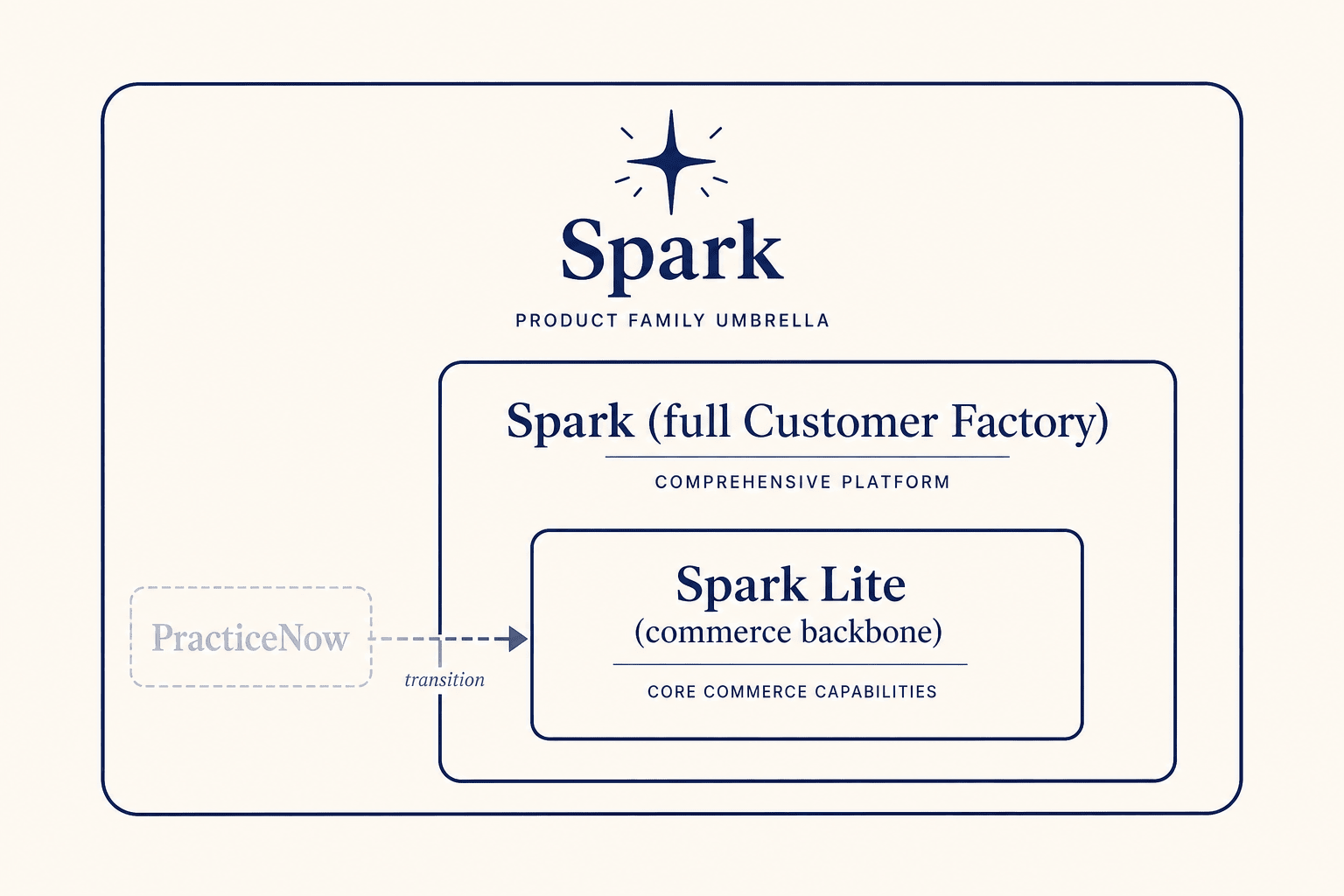
Spark is the umbrella and the flagship — the AI course engine and the full system described in this paper. Spark Lite is the commerce-and-operations backbone — payments, subscriptions, country-wise pricing, the day-to-day running of a teaching business. Many have known Spark Lite as PracticeNow, and it is being brought under the Spark name for one reason: there should be one product and one experience that carries an instructor from content, to course, to getting paid — not two tools bolted together. Spark Lite remains the right entry point for instructors who want the transactional backbone first; over time it folds into the larger whole.
A6. Domains where mastery stays hard to see
The examples in Section 2a are deliberately short — a few names to make the pattern concrete, not an inventory. Below is a longer partial list of hands-on teaching fields where depth tends to run deep but has little credible signal a prospective student can browse before they commit. We have omitted entire categories on purpose; treat this as illustrative, not exhaustive.
- Vocal coach
- Dance teacher
- Meditation teacher
- Martial arts instructor
- Woodworking instructor
- Pastry instructor
- Acting coach
- Public-speaking coach
- Calligraphy instructor
- Floral design instructor
- Sewing instructor
- Watercolor painting instructor
- Wine educator
- Breathwork facilitator
- Illustration instructor
- Leathercraft instructor
- Parenting coach
- Permaculture instructor
- Stained-glass instructor
- Mindfulness facilitator
What these share: the discipline sounds familiar at a glance, but the years of practice, study, and refinement underneath rarely have a license, famous institution, or other stand-in that makes the range of what someone has mastered browsable before a student signs up.
References
[1] Strauss, Yang & Mazzucato (2025). "Rich-Get-Richer"? Analyzing Content Creator Earnings (power-law α≈2). UCL IIPP / INET Oxford — inet.ox.ac.uk
[2] Goldman Sachs Research (2023/2025). The Creator Economy Could Approach Half-a-Trillion Dollars by 2027 — goldmansachs.com
[3] Jordan, K. (2014). Initial trends in enrolment and completion of MOOCs. IRRODL 15(1), 133–160 — irrodl.org
[4] UN Secretary-General (2020). Policy Brief: Education during COVID-19 and beyond — unsdg.un.org
[5] Class Central / Dhawal Shah (2021). By the Numbers: MOOCs in 2021 — classcentral.com
[6] HolonIQ. Global EdTech Market to Reach $404B by 2025 — holoniq.com
[7] Shapiro, C. & Varian, H. R. (1998). Information Rules. Harvard Business School Press — en.wikipedia.org
[8] Brynjolfsson, Li & Raymond (2025). Generative AI at Work. Quarterly Journal of Economics, 140(2), 889–942 — doi.org
[9] Sinek, S. (2009). Start With Why — the Golden Circle — simonsinek.com
[10] Heath, C. & Heath, D. (2007). Made to Stick — heathbrothers.com
[11] Maurya, A. Running Lean / Scaling Lean — the Customer Factory model — leanstack.com
[12] Collins, J. (2001). Good to Great — the Flywheel Effect — jimcollins.com
[13] Gerber, M. E. (1995). The E-Myth Revisited — harpercollins.com
[14] Ebbinghaus, H. (1885/1913). Memory: A Contribution to Experimental Psychology — psychclassics.yorku.ca
[15] Cepeda, Pashler, Vul, Wixted & Rohrer (2006). Distributed practice in verbal recall tasks. Psychological Bulletin, 132(3), 354–380 — doi.org
[16] Bloom, B. S. (1984). The 2 Sigma Problem. Educational Researcher, 13(6), 4–16 — doi.org
[17] VanLehn, K. (2011). The Relative Effectiveness of Human Tutoring, Intelligent Tutoring Systems, and Other Tutoring Systems. Educational Psychologist, 46(4), 197–221 — doi.org
[18] Kestin, Miller, Klales, Milbourne & Ponti (2025). AI tutoring outperforms in-class active learning: an RCT. Scientific Reports, 15, 97652 — doi.org
[19] Miller, G. A. (1956). The Magical Number Seven, Plus or Minus Two. Psychological Review, 63(2), 81–97 — doi.org
[20] Cowan, N. (2001). The magical number 4 in short-term memory. Behavioral and Brain Sciences, 24(1), 87–114 — doi.org
[21] Murre & Dros (2015). Replication and Analysis of Ebbinghaus' Forgetting Curve. PLoS ONE, 10(7), e0120644 — doi.org
[22] Hardt, Nader & Nadel (2013). Decay happens: the role of active forgetting in memory. Trends in Cognitive Sciences, 17(3), 111–120 — doi.org
[23] Roediger & Karpicke (2006). Test-Enhanced Learning. Psychological Science, 17(3), 249–255 — doi.org
[24] Rohrer & Taylor (2007). The shuffling of mathematics problems improves learning. Instructional Science, 35, 481–498 — doi.org
[25] Sweller, J. (1988). Cognitive load during problem solving. Cognitive Science, 12(2), 257–285 — doi.org
[26] Bloom, B. S. (1968). Learning for Mastery. Evaluation Comment, UCLA-CSEIP — eric.ed.gov
[27] Kulik, Kulik & Bangert-Drowns (1990). Effectiveness of Mastery Learning Programs: A Meta-Analysis. Review of Educational Research, 60(2), 265–299 — doi.org
[28] DigitalHumani — Plant a tree API (≈$1/tree; Ruby SDK) — digitalhumani.com
[29] Tree-Nation — Public API for gamified tree-planting milestones and Tree-Gifts — tree-nation.com
[30] Tree Planting Providers Compared (Ecologi REST API, reported ~$0.80/tree) — forestmatters.com
[31] Anderson, C. (2004/2006). The Long Tail — wired.com
[32] ICF (2023/2025). Global Coaching Study, fieldwork by PwC — coachingfederation.org
[33] Pornpitakpan, C. (2004). The Persuasiveness of Source Credibility: A Critical Review of Five Decades' Evidence. Journal of Applied Social Psychology, 34(2), 243–281 — doi.org
[34] Rosenthal, R., & Jacobson, L. (1968). Pygmalion in the Classroom. The Urban Review, 3(1), 16–20 — doi.org
[35] Darby, M. R. & Karni, E. (1973). Free Competition and the Optimal Amount of Fraud. Journal of Law and Economics, 16(1), 67–88 — introduces the concept of the "credence good" — doi.org