Case Study
How two high school tutors turned 2,500+ hours of Zoom classes into structured courses
Unni and Amrutha teach math, physics, chemistry, and biology to 100+ students across grades 8-12. Since February 2025, they've been using Spark to complement their live Zoom classes - automatically converting recordings into structured courses with study notes, quizzes, and an AI tutor.
The Context
Unni teaches math for 8th grade and physics for grades 9-12, while Amrutha teaches chemistry and biology for grades 9-12. Both teach entirely on Zoom, conducting live classes that run 60-90 minutes each, typically 5 classes per day.
They've been using PracticeNow (Spark's sister product) since 2020 to manage student subscriptions and access to their Zoom classes, including automatic recording management. This integration made it seamless to pull Zoom recordings directly into Spark when they started pilot testing in February 2025.
With over 100 students across multiple grades and subjects, managing access, subscriptions, and content delivery was becoming increasingly complex. They needed a system that could scale with their teaching practice while maintaining the personal touch their students valued.
The Challenge
While PracticeNow handled subscriptions and Zoom access well, students were struggling to effectively use the raw Zoom recordings for revision. The problems were clear:
- Unstructured content: 90-minute recordings without clear sections made it hard for students to find specific topics
- No study materials: Students had to rewatch entire classes to review - inefficient for busy students preparing for CBSE exams
- Limited assessment: No easy way to generate quizzes to check understanding between live classes
- Support overhead: Answering repetitive questions about topics already covered in recordings
- Access management: Ensuring students only see content for their grade and subjects without manual oversight
Before Spark:
Students had to scrub through hours of video to find specific concepts. Tutors spent significant time answering questions that could be answered by reviewing the recordings.
The Solution
Starting in February 2025, Unni and Amrutha became early pilot customers for Spark. Since their Zoom account was already connected to PracticeNow, videos automatically flowed from Zoom Cloud into Spark for processing.
Every day, new class recordings are automatically pulled from Zoom, processed through Spark's pipeline, and made available to students as structured courses within hours. No manual upload, no editing, no formatting.
The system has processed over 1,000 videos - totaling more than 2,500 hours of content - with every variation imaginable across four STEM subjects at different grade levels. This real-world usage has been instrumental in refining Spark's course structure, formula rendering, and accuracy controls.
Key Features in Action
account_tree Course Structure & Micro-Learning
Each 90-minute Zoom class is automatically broken down into chapters with micro-sections (typically 3-8 minutes each). Students can jump directly to specific topics instead of scrubbing through long recordings.
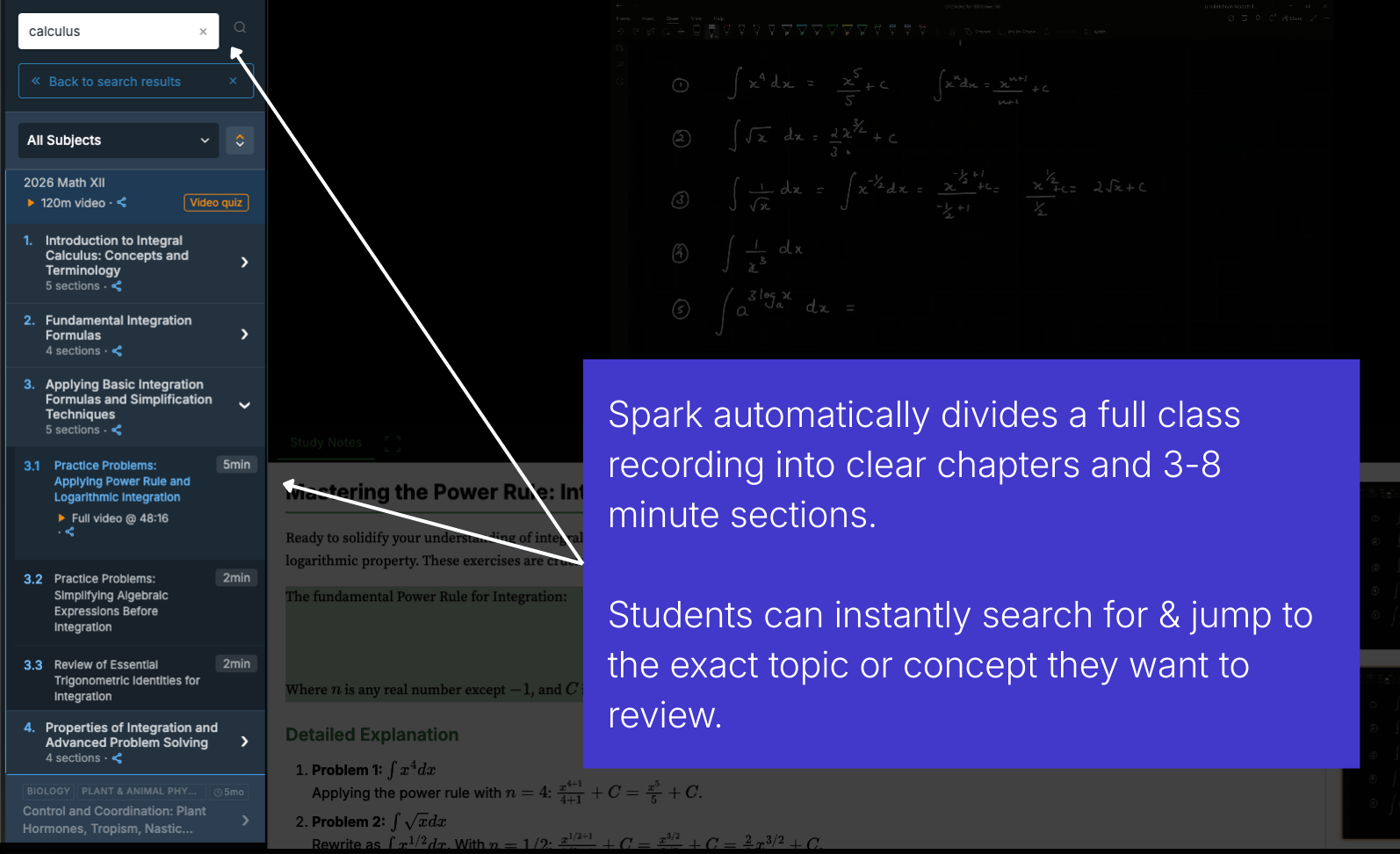
Course structure
90-minute class broken into chapters with micro-sections for easy navigation.
Tap an image to view it full screen.
note_alt Study Notes with Formula Rendering
Accurate study notes are critical for STEM subjects. Spark generates detailed notes with proper formula rendering using MathJax, ensuring students can review complex mathematical and scientific concepts without watching entire videos.
The system uses a maker-checker process to ensure notes are scientifically accurate and stay within the bounds of what was actually taught - critical when students rely on these notes for exam preparation.
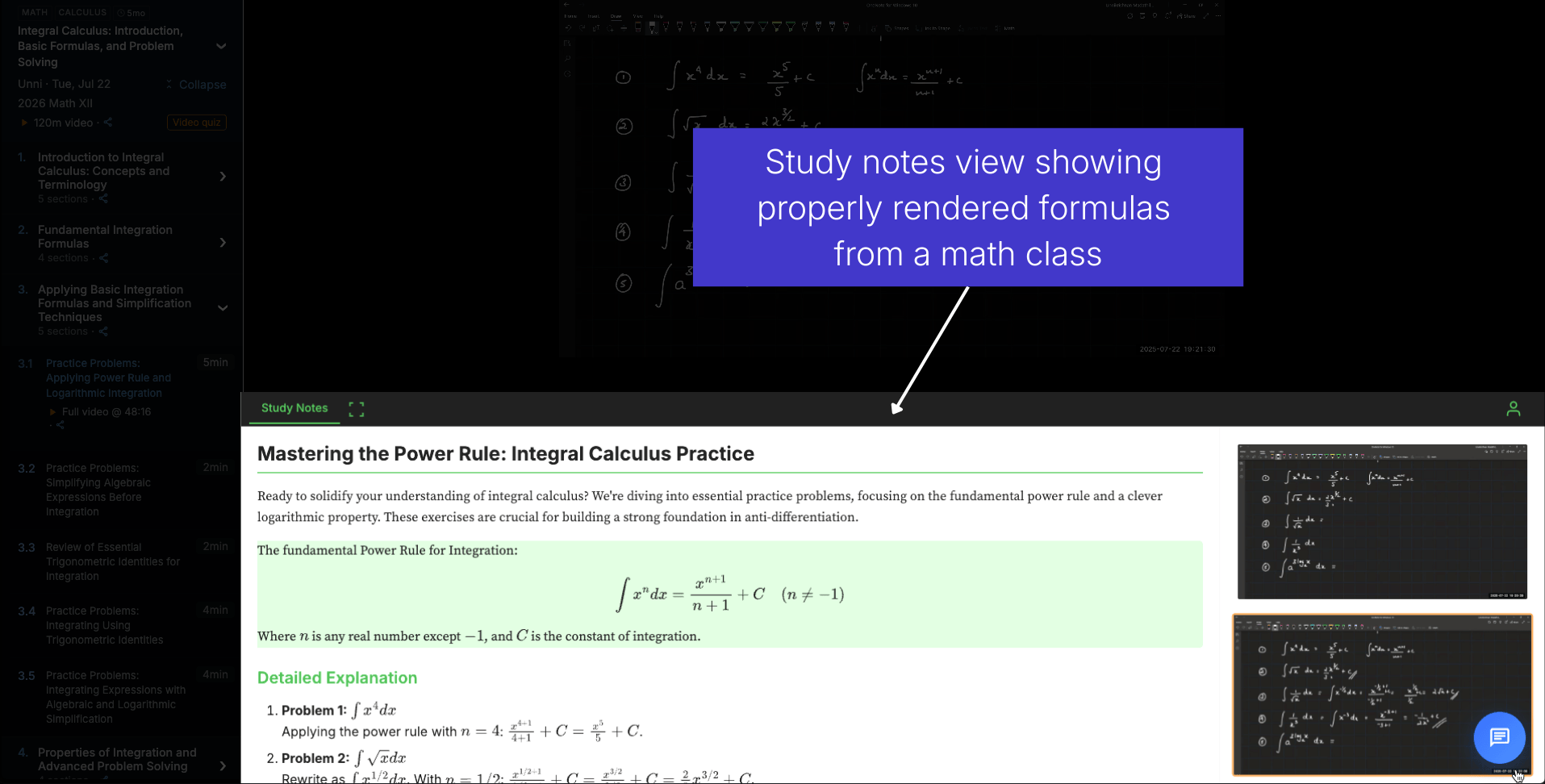
Study notes with formulas
Accurate notes with properly rendered mathematical and chemical formulas.
Tap an image to view it full screen.
quiz Quizzes with Multiple Difficulty Levels
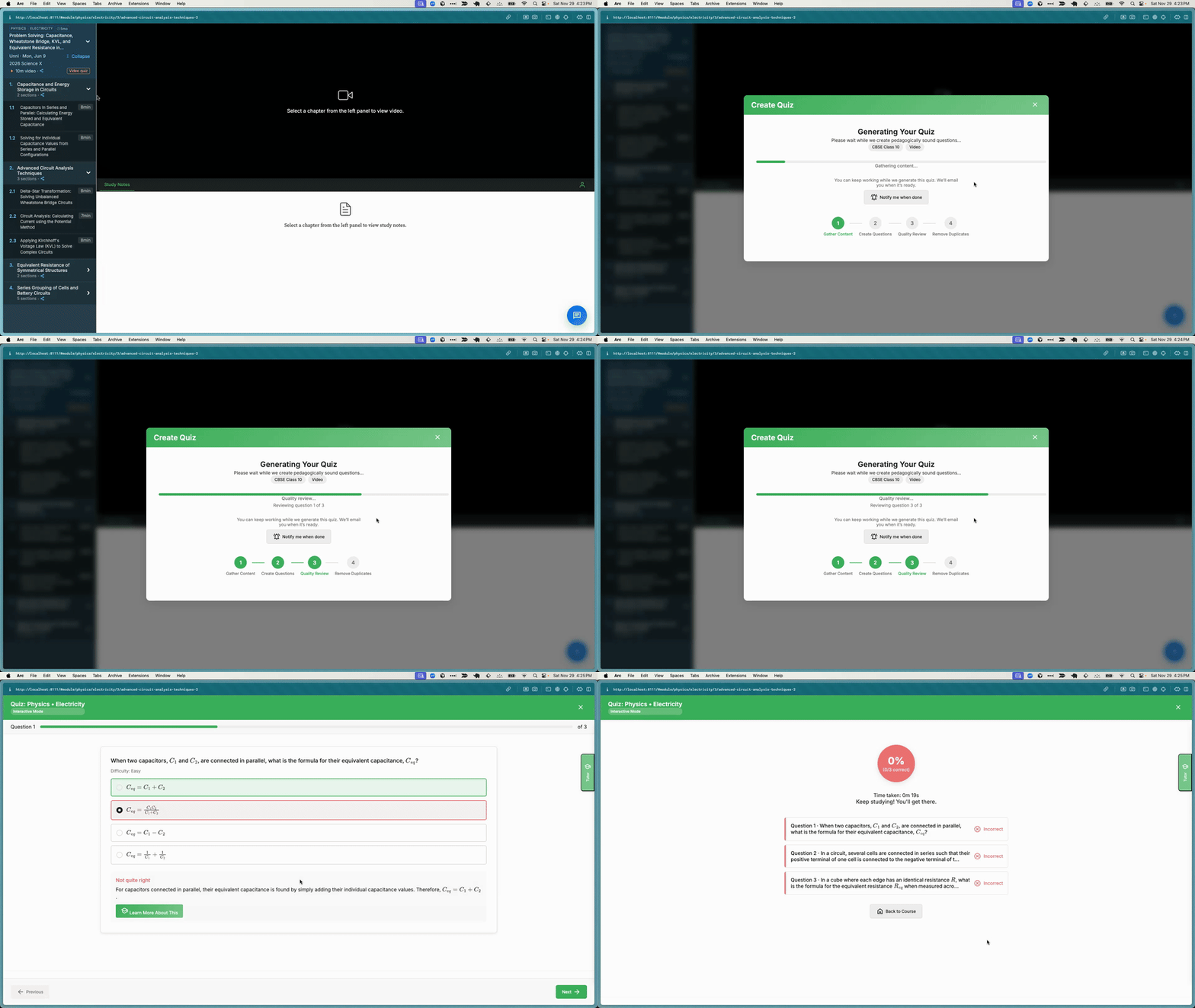
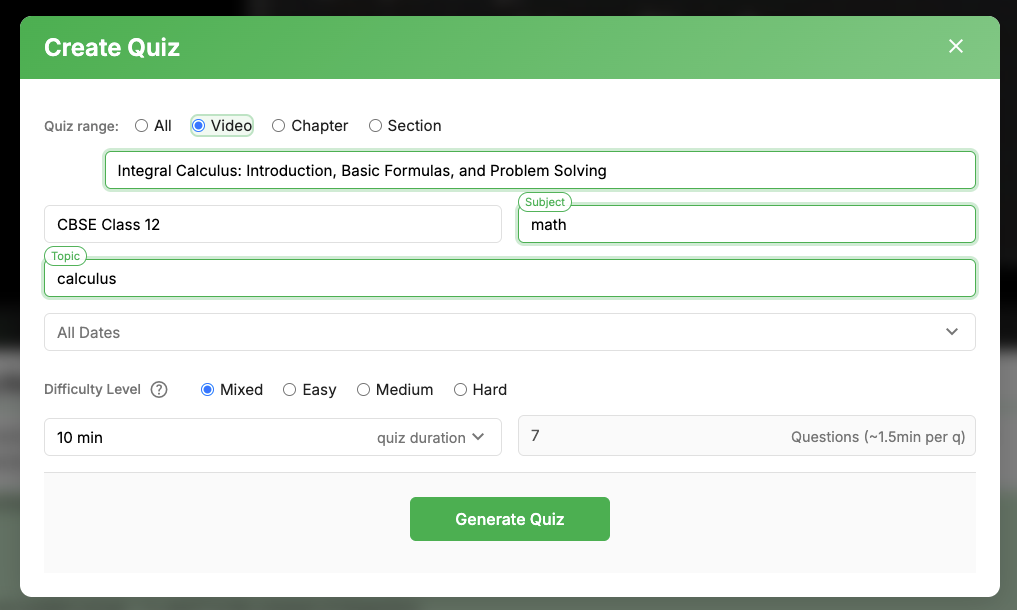
Tutors frequently generate quizzes in two modes: per-video (testing understanding of a specific class) or across-videos (comprehensive assessments covering multiple classes). Questions are aligned with Bloom's taxonomy, ranging from recall-based (easy) to application-level scenarios (hard).
Quiz generation
Generate quizzes for a specific video or across multiple videos with difficulty controls.
Quiz interface
Students can take quizzes with multiple difficulty levels aligned to Bloom's taxonomy.
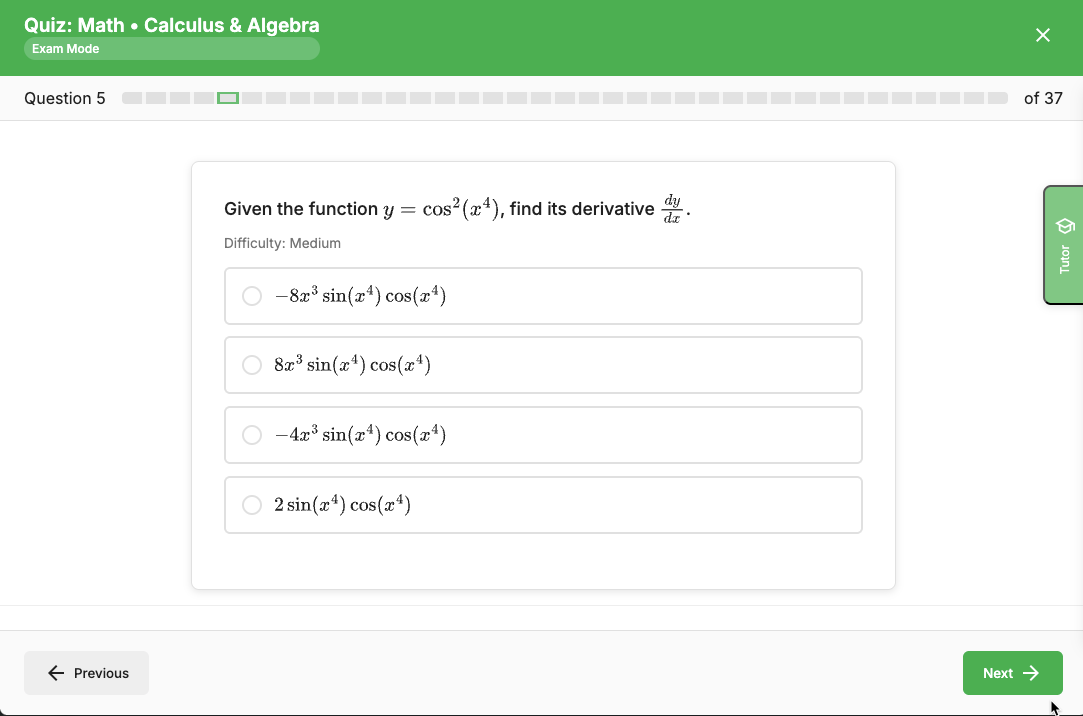
Quiz questions
Questions range from recall-based (easy) to application-level scenarios (hard).
Tap an image to view it full screen.
insights Live Quiz Reports
During live Zoom classes, tutors can run quizzes and see real-time reports showing which students are struggling, which questions are most difficult, and where the class needs more support. This enables immediate intervention and targeted review.

Live quiz dashboard
Real-time view of student progress and question-level insights during live classes.
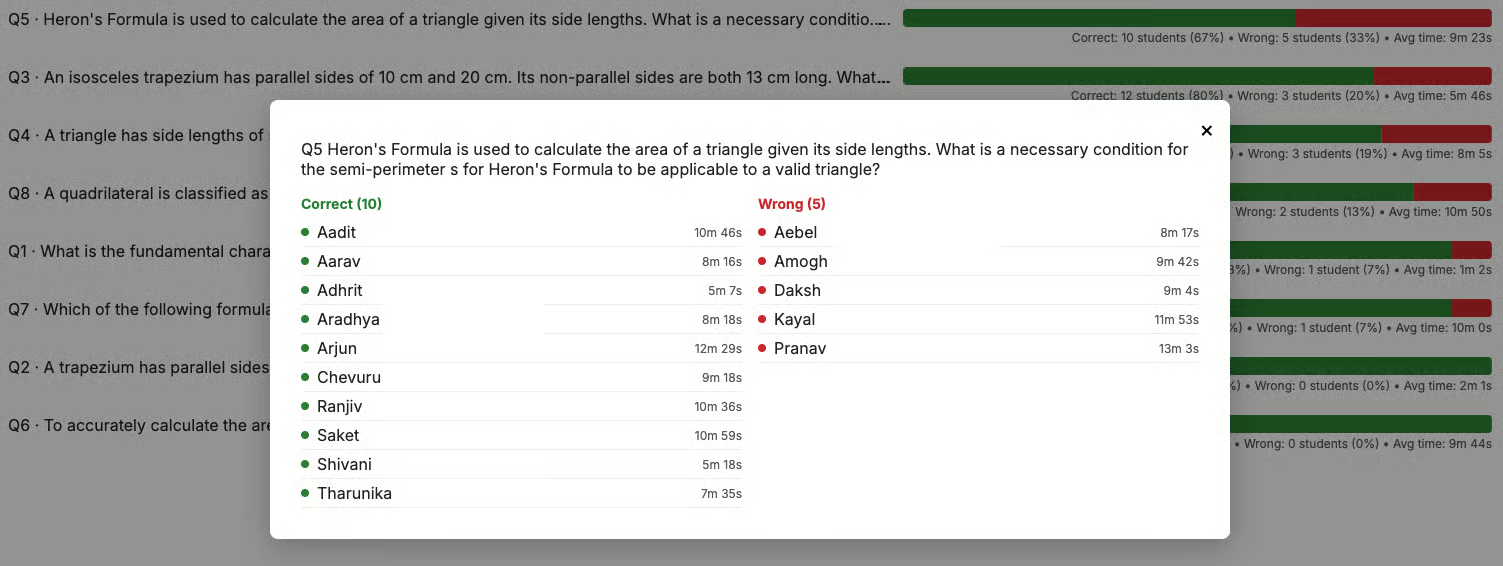
Question-level insights
See which questions are most difficult and where the class needs more support.
Tap an image to view it full screen.
verified_user Granular Access Control
With 100+ students across multiple grades (8-12) and subjects (math, physics, chemistry, biology), access control is critical. The system ensures students only see content relevant to their enrollment.
- Grade-level filtering: 8th grade students only see 8th grade content, 10th grade students only see 9-12 grade content
- Subject-level filtering: Students enrolled only in math don't see science videos, and vice versa
- Multi-subject support: Students can be enrolled in both math and science, seeing both sets of content
This granular authorization model scales to enterprises using LDAP/SSO, where access can be controlled by employee role, department, or clearance level. For universities, it ensures only enrolled students access course content.
search Semantic Search & Knowledge Base
Students can search across 500-700 hours of content per grade using natural language queries. Instead of scrubbing through hours of video on Google Drive, they find specific topics instantly.
forum AI Tutor (Course-Grounded)
The AI tutor answers student questions by citing content from actual lectures, staying within the bounds of what was taught. This reduces repetitive email queries and helps students get instant answers to specific questions.
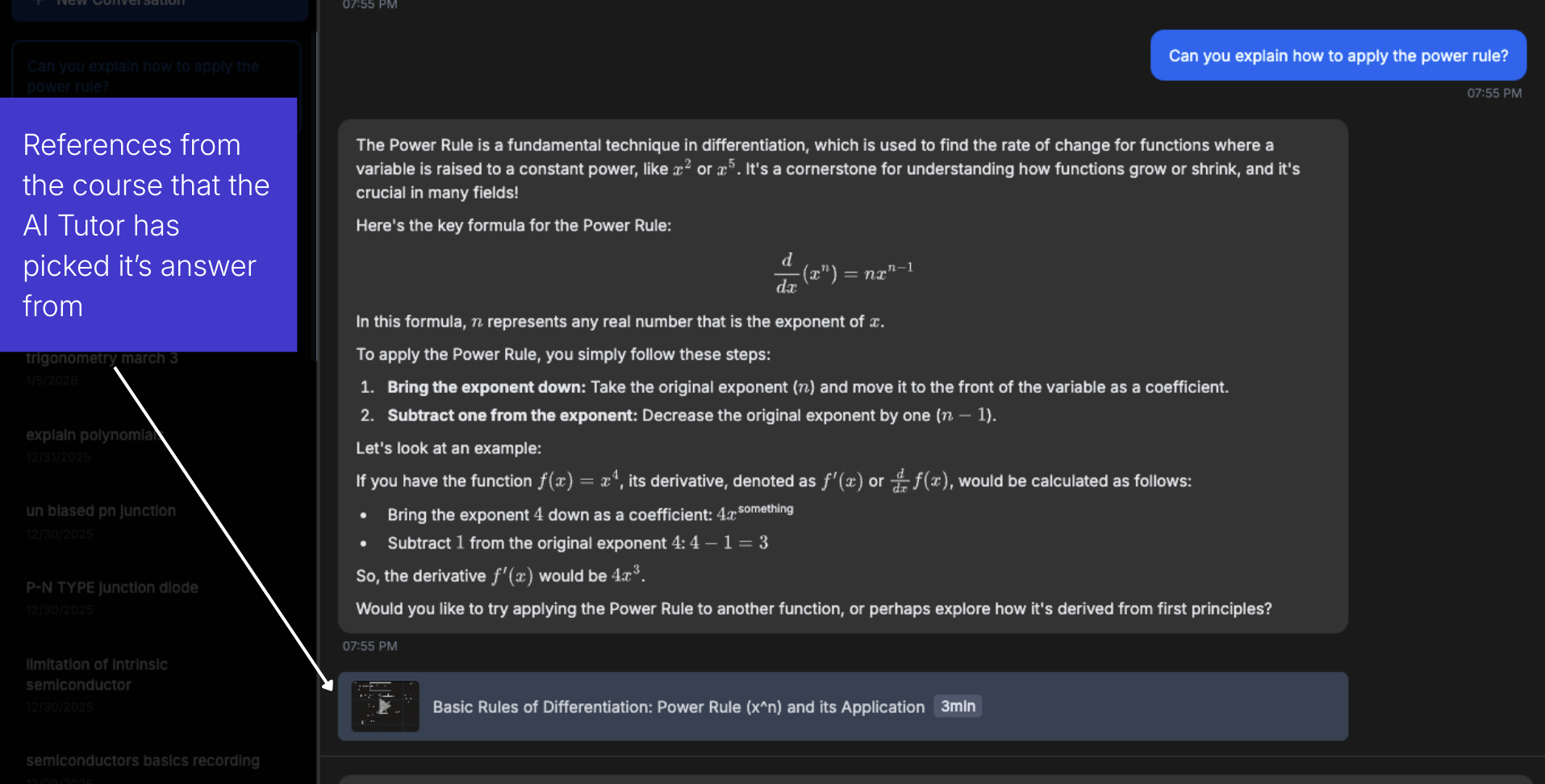
AI tutor with course references
The AI tutor cites specific content from lectures, showing students exactly where answers come from.
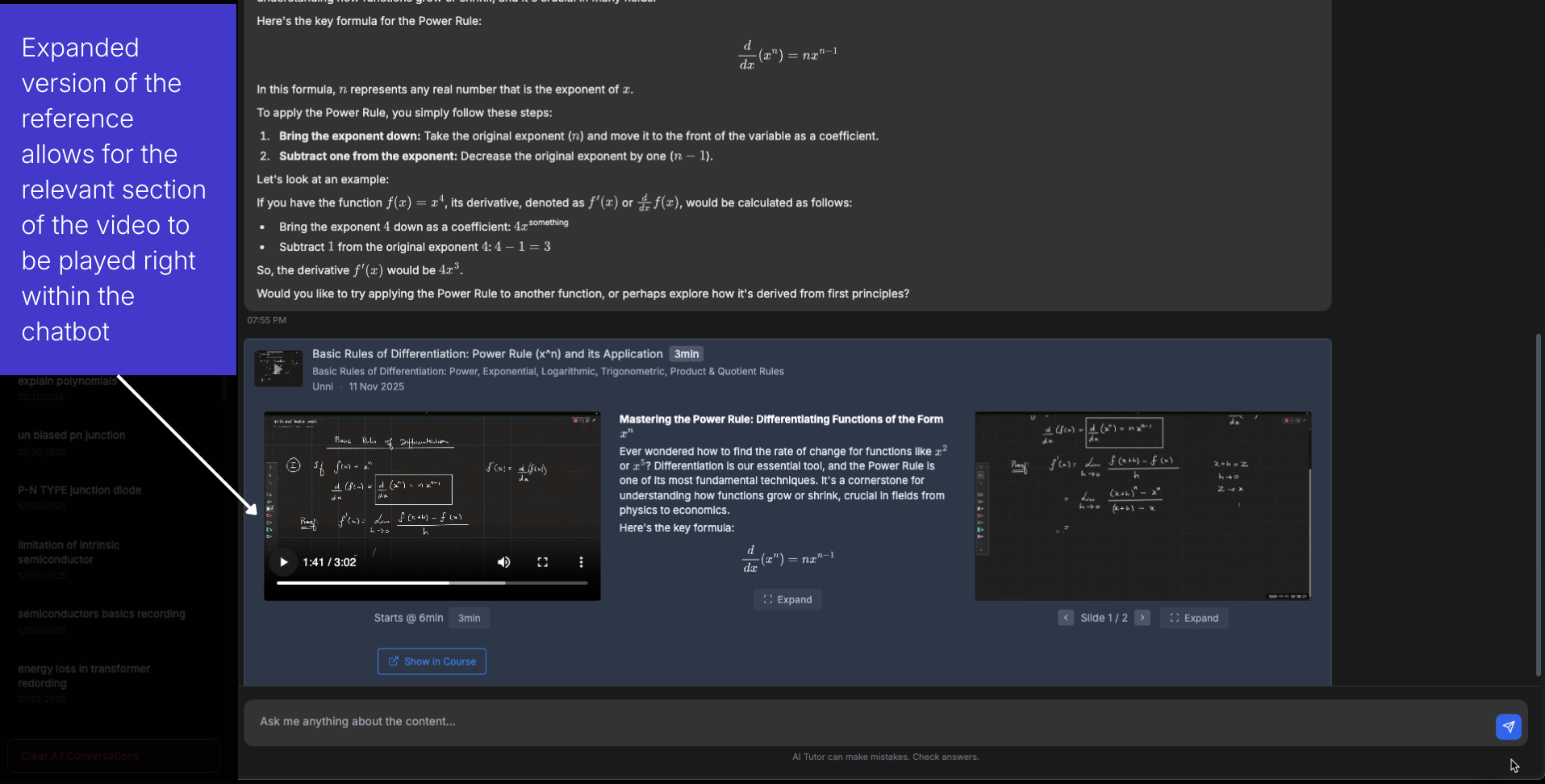
Interactive video playback
Students can watch relevant video sections directly within the chatbot interface.
Tap an image to view it full screen.
Student Impact Stories
Catching Up After Vacation
A student missed 4-5 days of classes while on vacation. Rather than watching hours of video recordings, she read through all the study notes and caught up at a much faster pace. The structured notes allowed her to quickly absorb the material she missed without the time commitment of watching full class recordings.
Self-Service Learning Discovery
A 12th grade student (the tutors' daughter) had a specific chemistry question while her parents were busy. Instead of waiting for their response, she used semantic search to find the relevant content, then used the AI tutor to get her question answered.
More interestingly, while searching and exploring, she discovered related concepts she hadn't encountered before - demonstrating how the knowledge base enables deeper, self-directed learning beyond the immediate question.
The Results
Automatic processing: 5 classes per day automatically converted into structured courses - no manual work required
Reduced support load: AI tutor handles common questions, freeing tutors to focus on high-value interactions
Better student outcomes: Students can catch up faster, find specific topics instantly, and get instant answers to questions
Scalable access control: Granular authorization by grade and subject scales to 100+ students without manual oversight
Real-time insights: Live quiz reports enable immediate intervention during classes to address learning gaps
Ready to transform your teaching?
See which Spark features matter most for your role, or explore other case studies.